

A new way to explore
contemporary art and ideas
Art and the politics of extraction
Artists trace the impact of mining, resource depletion, and global supply chains on communities and environments.
[ KADIST ]
[ KADIST ]
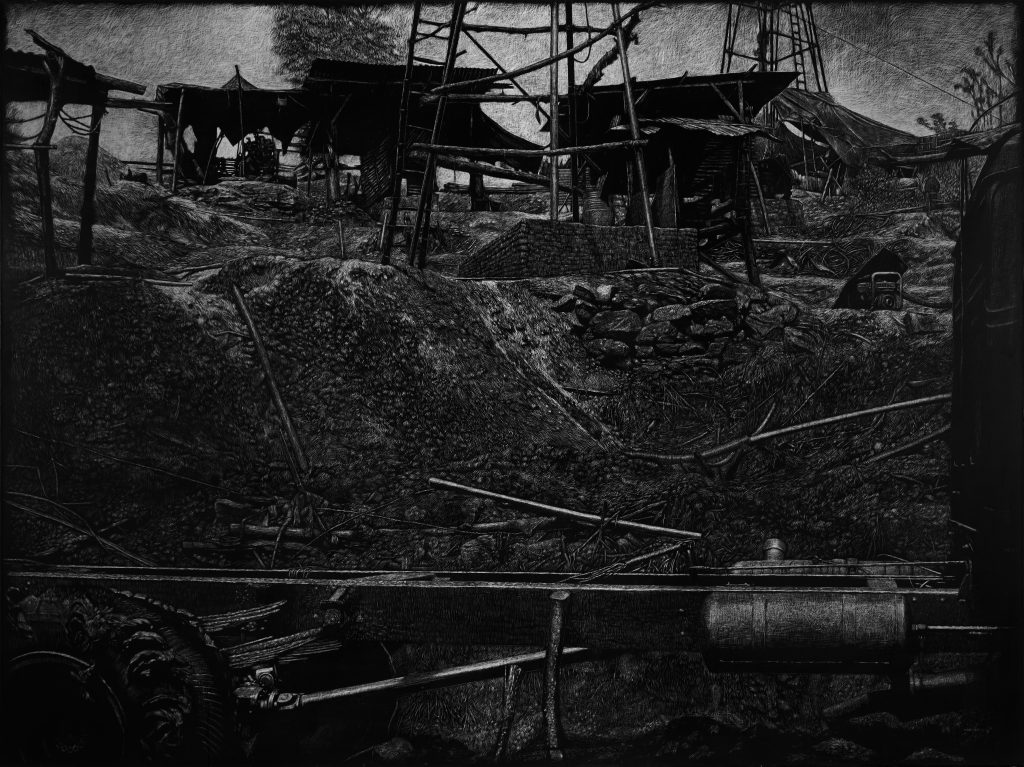
Wonocolo
Maryanto’s depiction of the Wonocolo oil mine frames extraction as a postcolonial ecology of violence, where Dutch imperial infrastructure and contemporary neo-colonial corporate greed converge to scar land and social life under the guise of local sovereignty.
By translating printmaking’s sgraffito-like incision into painting and evacuating the scene of human figures, the work stages a forensic critique of political corruption and economic dependency, exposing how landscapes become archives of power, environmental catastrophe, and contested rights.
Read more
[ KADIST ]
[ e-flux ]
[ e-flux ]
Uncommoning Nature
Colonial-modern power is framed as an ongoing “anthropo-not-seen”: a world-making war that enforces the nature/culture split to render territories legible as resources, while Indigenous and local relational ontologies (kinship with rivers, lagoons, mountains) both exceed and interrupt that partition.
Through conflicts over extraction, the text theorizes “ecologized nature” and ontological disagreement as political forces, proposing alliances and a commons built from constitutive divergence—uncommoning universal Nature to expose and contest the one-world world’s claim to progress and the common good.
Read more

[ e-flux ]
[ e-flux ]
[ e-flux ]
No Aesthetic Autonomy Without Labor Autonomy
Conceptual art’s vaunted “aesthetic autonomy” is shown to depend on labor alienation and supply-chain repression, where authorship and value are secured by legally and ideologically separating the idea from the exploited hands that execute it. Read through Marxist/Situationist critique and anti-colonial political economy, the banana ready-made becomes an evacuated symbol that aestheticizes domination—masking plantation violence, subcontracted artisanship, and class warfare while galleries and markets weaponize false critique to preserve capitalist hierarchy.
Read more

[ e-flux ]
[ KADIST ]
[ KADIST ]
Man's Hat with photograph in the hatband
Appropriation and serial collecting are mobilized to de-authorize the artwork, resisting commodification through untitled, undated, infinitely reproducible assemblages that reframe everyday objects as aesthetic events. Minimal display and Duchamp/Beuys-inflected readymade strategies produce a quasi-portraiture where the banal is re-enchanted, foregrounding the absurd/poetic collision and interrogating the value and sacralization of artistic labor.
Read more

[ KADIST ]
Back to top