

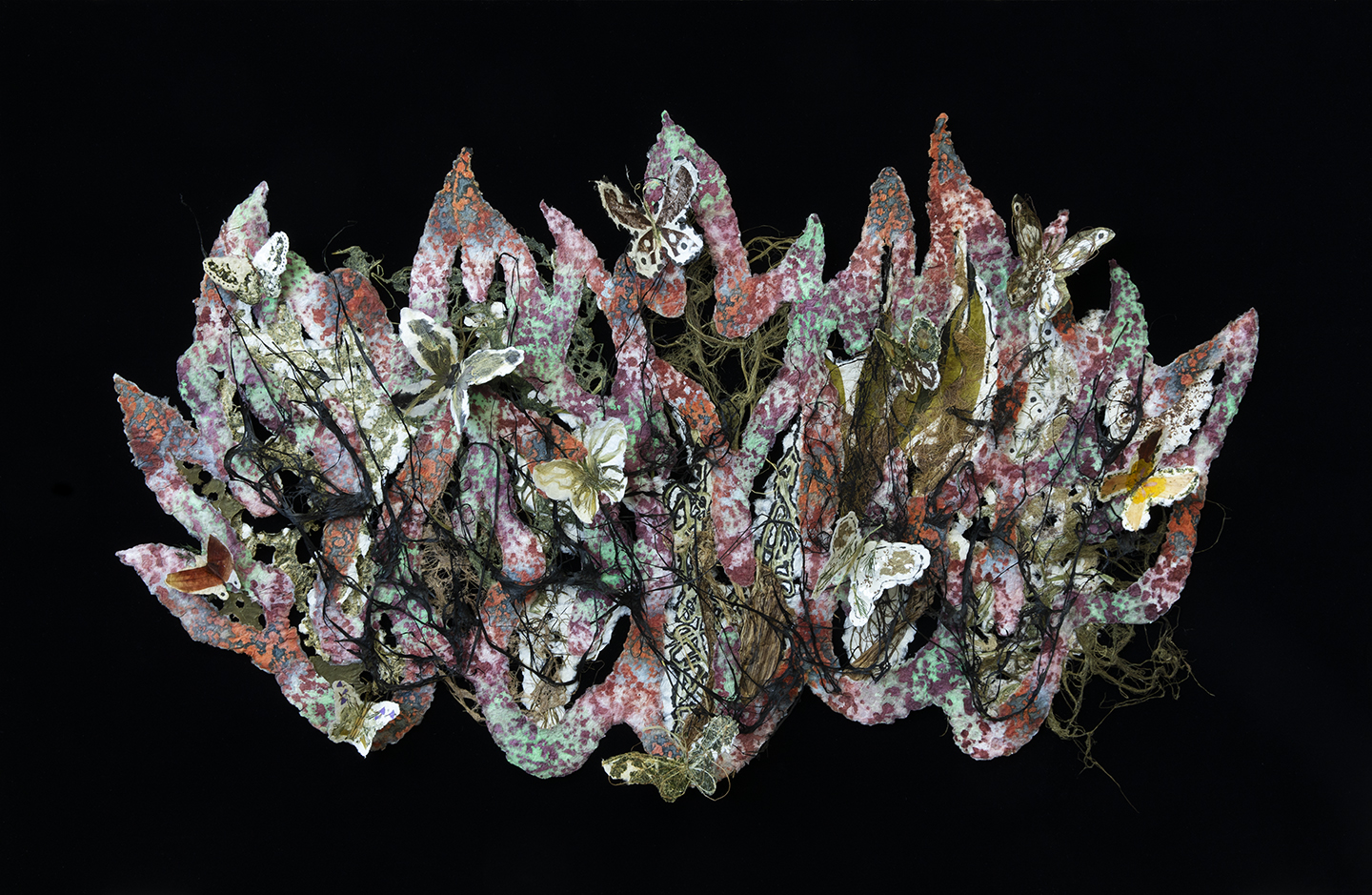
Enzo Camacho and Ami Lien, Flame Garden (nitrates), 2024. Courtesy of the artists.
Portending contemporary depravities to come, two art pieces made auction headlines at the end of 2024. First was Duchamp’s infamous ready-made In Advance of the Broken Arm, which sold for $3.075 million; then, in acceleration, Maurizio Cattelan’s Comedian—a banana taped onto a wall—fetched $6.2 million. The piece was purchased by a crypto overlord who proceeded to “eat” the work as a way to partake in the presence and history of transnational class warfare. Though this is not how either event was described.
For those unfamiliar with the antics of Italian conceptual artist Cattelan, it may be important to return to an earlier piece from 2003: Untitled (Stephanie), a wax bust of the nineties supermodel-turned-actress Stephanie Seymour. In a pulpy New York Post review of Don Thompson’s book The Supermodel and the Brillo Box: Back Stories and Peculiar Economics from the World of Contemporary Art, Maureen Callahan explains how Untitled (Stephanie) came to be.1 The work was commissioned by Seymour’s sometime billionaire husband Peter Brant, who charged the artist to create an original work of art. After dining with the couple, Cattelan told Brant that his “real trophy” was his wife, leading the artist to oversee the production of a topless wax figure of Seymour.
Buried in the auction footnotes about Stephanie is a comment about how Cattelan hired the artist Daniel Druet, a former master at the Musée Grévin wax museum, to create the bust. Druet proceeded to create most of Cattelan’s infamous works, from Him—a kneeling child-like figurine that depicts a revision of Hitler seeking forgiveness—to La Nona Ora (1999), and so many others. The categories separating artists from artisans who labor on behalf of museums for brands like Cattelan remain fixed through a reactionary system and a colonial legal regime that continues to insist that ideas can be divided from their execution, and that context can be stripped away from those assigned to its making.
While Cattelan is often noted as a dark humor prankster, the vendor who sold the banana for the auction, Shah Alam, tells the New York Times that he feels like “the joke is at his expense.”2 A piece like Untitled (Stephanie)—as a wax bust—does not visually announce the complicated tentacles of its labor and material history, whereas Comedian—as unmade3—explicitly lampoons the mode of production. The banana and the tape are extracted materials, which the artist exploits to his will. It would be absurdist and naive to wonder about the labor and circulation processes of the banana and tape, and to question their symbolic function: this is clear in the writing surrounding the sale. You either get it or you don’t. From fawning interviews to primers on conceptual art, to even unenthused critiques of the art market, there seems to be an acceptance of the unmade “ready-made,” its appraisal and sale, and an under-examination of any material processes, thereby aestheticizing domination.
***
Before it became the name of a clothing franchise and mall staple, the phrase “banana republic” described, according to political scientists, an impoverished, formerly colonized nation-state, unevenly developed through the mass export of bananas. In the late nineteenth and early twentieth centuries, the term became shorthand for Colombia, Honduras, Costa Rica, Guatemala, and other countries in Central America. The United Fruit Company, now Chiquita Brands International, supported coups throughout the region and has become synonymous with the ongoing presence of corporate neocolonialism. Banana farming is also part and parcel of ongoing environmental collapse, as this corporate enterprise is responsible for deforestation and erodes biodiversity. But this is not the public association with the fruit.
In examining the evacuation of symbols, artist Bruno Zhu connects the erasure of meaning to the history of subsumed class warfare. In License to Live, he describes expunged class history as situated in playing cards:
While they are socially naturalized, playing cards also contain interesting and charged histories. Historically in Europe, card suits alluded to social stratification or weaponry … symbols that represented social classes: cups (hearts) for the clergy, swords (spades) for the nobility, diamonds for the merchant class, and clubs for the peasantry. These graphics have been so flattened and vectorized over time that they infiltrate our visual culture hollowed of any meaning.
The process of winning and losing a card game becomes remarkable when we consider how each result might speak to the conditions of medieval class war, and the processes through which the loss of a particular group might have been widely understood. When card symbols are attached to their historical context and meaning, their naturalized hierarchies are elucidated. Akin to evacuated symbols once full of meaning, the banana becomes introduced worldwide through the violence that makes and masks colonial infrastructure; and through advertisement, the fruit becomes attached to health, breakfast, dessert. Associated with pranks via filmic representations (the banana peel slip, its usage in phallic innuendos, etc.), and inserted into cartoons as part of its lighthearted innocence, and posited as color, vibrance, and mischief—as seen in The Comedian—the banana partakes in the epilogue of abstracted graphics both full of and denied signification.4
As card symbols trace the process of enforced dematerialization, Zhu’s discussion of flattened symbols offers another way to examine the art market as the site of class warfare. Zhu describes symbols that are “ubiquitous and emptied of meaning because they have become so historically saturated over time.” The sale of Comedian and In Advance of a Broken Arm, the renovation of the Frick Collection: these are under-described present-day applications of domination. Unlike the wars of the past, this contemporary war is often deprived of the language required for basic description. Mustapha Khayati clarifies how “concepts of radical critique suffer the same fate as the proletariat: they are deprived of their history, cut off from their roots. They become grist for power’s thinking machines.” A key feature of this machine is the evacuation of meaning, the narration of systematic labor exploitation as merely a concern of individual preference (get another job), and a fundamental narrative suppression of the supply chain.
To speculatively reconstruct the supply chain: Mr. Alam tells the New York Times that he sells bananas for thirty-five cents apiece, or four for a dollar, and is paid twelve dollars an hour and works twelve-hour shifts; Sotheby’s buys one from him on behalf of an auction and sells the piece for over $6 million. The crypto buyer proceeds to cannibalize the purchase in order to further embellish various disembodied grifts. (In May 2025, he was among the attendees at the dinner for major investors in a certain meme coin.) What is not explicit but can be gauged is how someone else sold the fruit to the owner of the stand. Before this sale, many people who are not in the United States or Europe tended to the banana plant, soil, and water, and many others picked and packed this and other crops. Not to mention the various middlemen, who are only being invoked as a reminder that management overhead remains steep, and various corporations and subcontractors partake in the scheme and may or may not receive subsidies for overseeing this extraction. Neocolonial dynamics cannot be denied when we examine how little the workers in the producing country make compared to the profits earned by the exporters. Citing anthropologist Darcy Ribeiro, Eduardo Galeano writes that “for every dollar produced from exporting bananas, just eleven cents remain in the producing country. Of those eleven cents, only a meager portion goes to the plantation workers. Do the proportions change when a Latin American country exports automobiles?” This is to ask: If the conditions remain as the objects are altered, how might the conditions be transformed?
A fantastical text concerning transformation, Jacob Wren’s novel Dry Your Tears to Perfect Your Aim follows a narrator to an unidentified liberated zone, where noncapitalist, collective practices are formed, reworked, and communalized. The zone is unidyllic as it continues to be bombed and fired upon by nearby and faraway imperialists. Amidst the daily raids, the narrator is allowed to sit in on town meetings, where economics and trade become reinvented. In one such meeting, the narrator hears a woman discussing how concerns over goods being “too expensive” must also be applied to items being “too cheap.” She says, “Just as you mustn’t accept a price that is too high, you also must not fight, nor constantly search, for a price that is too low … You need to understand that those who sell you these things also need to live.”
This gallows humor highlights the disparities between life and death and locates a price so low that some are explicitly not allowed to live. Tellingly, Cattelan, the supposed prankster who will sell and hire others to do everything and treats all matter as dispensable, predictably imposes a boundary on engagement with his own critique. In response to Mr. Alam’s critiques of his exploitation, Cattelan stated that “art, by its nature, does not solve problems—if it did, it would be politics.” Evading criticism through a well-worn notion of aesthetic isolationism, Cattelan offers art that ideologically affirms the status quo, upholding supply-chain repression and enforcing and extending class domination. (He offers, in other words, enmeshed and predictable capitalism-as-art.)
Regarding that which is purposefully degraded and denied in the supply chain: when Daniel Druet, the artist who made Untitled (Stephanie), sued Cattelan’s gallery over authorship and payment, contemporary artists such as Sophie Calle signed an open letter in support of Cattelan. It stated: “Daniel Druet’s quest for recognition as the exclusive author of the works imagined by Maurizio Cattelan opens the door to the disqualification of conceptual art.” Does the qualification of conceptual art hinge on the erasure of laborers and the repression of its making? The artists who signed the letter seem to think so. Other than capitalism, what qualifies conceptual art?
Cattelan’s gallerist, Emmanuel Perrotin, disorients the vocabulary of power and the location of the abused to affirm the exploitation naturalized (but not natural) in preexisting labor hierarchies. Perrotin tells Le Monde that “Druet will remain in art history. If he loses, the jurisprudence that we’ve waited for so long will finally protect artists against potential abuses of power by manufacturers we don’t even know. If he wins, all artists will be attacked, and it will be the end of contemporary art in France.” Inverting critiques of capital and capitalism, Perrotin contends that rather than the subcontracted artisans and laborers, the artists and galleries must be protected from the “attack” and “power” of artisans and laborers. In wanting to dismiss structures of accountability, Perrotin reveals his elite position on the hierarchy by pointing to the anonymity of those below (“manufacturers we don’t even know”).
Invoking Mustapha Khayati—former member of the Situationist International—once more, he writes about the function of language in counterrevolutionary, reactionary frameworks. His analysis is relevant to the Cattelan variant of reaction. In 1966 Khayati writes,
The decline of radical thought considerably increases the power of words, the words of power … Words forged by revolutionary criticism are like partisans’ weapons: abandoned on the battlefield, they fall into the hands of the counterrevolution. And like prisoners of war, they are subjected to forced labor. Our most direct enemies are the proponents and established functionaries of false critique.5
Instrumentalizing the thrust of Marxist and feminist theory—which clarify the language of power and identify those exploited and abused—Perrotin evacuates their meaning to maintain the alienation of labor and to suppress protest. It is agreed that the artist or the gallery or the auction house sells an authorized object they have no material relationship to for $6 million or $17 million: their asking price knows no bounds. The laborers who make the production possible are openly situated as unimaginative and receive not even a fraction of the sale price. The absence of just compensation and attribution is not recognized as the crisis or the abuse—such is the function of false critique. It is the laborers’ potential request for compensation and attribution, their anonymity, and their existence that constitute the threat and power. The judges rule against Druet in favor of the gallery, and the result of the case can best be summed up by Marx: “The alienation of the worker in his product means not only that his labour becomes an object … It means that the life which he has conferred on the object confronts him as something hostile and alien.”
The rise of and sale of works branded as Cattelan’s by him and the gallery, the ongoing inflation of all markets, and the elevation of conceptual and managerial forms to the most sacred position in contemporary art are symptomatic of the decline of radical thought and the abandonment of language. The inventors of revolutionary criticism have, in Khayati’s words, become prisoners of war in the counterrevolution. And we live in the paradise of false critique.
In the compromised milieu of pragmatism and utilitarianism—which infects liberal and left discourse as much as it is championed by neoliberal war hawks—Mr. Alam’s invocation remains unexamined: “Those who bought it, what kind of people are they?” he asked. “Do they not know what a banana is?” The labor dynamic he locates, in which he who is among the least paid is sacrificed to produce the joke, clarifies how contemporary aesthetics remain situated in relation to exploitation: explicitly, the exploitation pivotal to their aesthetics.
***
Every few years someone publishes a brilliant essay that examines capitalism and contemporary art, and the political function of the art market. The article is widely shared and many agree that the art market should implode, but irrespective of consensus, the patron class somehow remains intact. A few years pass and then another marvelous essay comes forth. Is the erasure of critique compulsive and thus the current writing of such essays compensatory? Market apologists often point to a different moment in history when things looked the same as a way to suppress transformation. Sophisticated citations might include W. G. Sebald’s The Rings of Saturn, where he connects chattel slavery to European paintings, writing,
The capital amassed in the eighteenth and nineteenth century through various forms of slave economy is still in circulation … One of the most tried and tested ways of legitimizing this kind of money has always been patronage of the arts, the purchase and exhibiting of paintings and sculptures … as if all works of art were coated with a sugar glaze or indeed made completely of sugar.
Such citations are to serve as a conclusion, a see it’s all the same so relax ruse. Rather than careful critique and careful dismissals, others participate in the wholesale dismissal of the realm of aesthetics, as undifferentiated from markets. Discussions about wealth and expropriation quickly become about everything else. How to discuss class warfare in a way that doesn’t become the fodder for some neoliberal or parochial moral? How to create weapons where neither orthodox state socialists nor race-neutral antagonists nor any libertarian and their gallerists chums might seize and appropriate the language and symbols for their worlds? How to critique class in a non-populist way, but in the material ways that situate fantasies of the people?
Donna Miranda and Angelo V. Suarez discuss the context of the 2023 Cattelan retrospective at the Leeum Museum—the gallery of the Samsung Corporation—in Korea, where the Comedian banana was featured and eaten. The artists emphasize how the exported banana at the exhibition came from the Philippines, and detail the state violence against farmers that maintains the country’s fruit exports. Likewise, Dominic Zinampan connects contemporary art spaces in the Philippines to the subjugation of agricultural laborers, as Lapanday Foods Corporation (LFC), the primary banana exporter in the country, routinely opens fire on protesting farmers and denies their autonomy.
Concerning the politics of contemporary art and gallery spaces, Enzo Camacho and Ami Lien6 write: “That the support structure for contemporary art would rest on the violence of corporate power should come as no surprise to anyone anywhere.” And in the case of the Philippines,
It should be remembered that the Philippines is the site of one of the longest-running Communist insurgencies in the world, an armed civil conflict that has claimed tens of thousands of lives since its beginning in 1969 and has been particularly concentrated in the southern island of Mindanao, where the LFC plantations are located.7
Camacho and Lien elucidate how the supply chain of contemporary art begins at the plantation.8 And while auction houses, gallerists, and artist brands narrate the ongoing counterrevolution through the forced labor of revolutionary language, Camacho and Lien press upon the actuality of ongoing insurgencies as the foci to be born.