

A new way to explore
contemporary art and ideas
Why do ruins fascinate us?
Ruins embody collapse and possibility, prompting artists to reflect on cycles of destruction, memory, and rebirth.
[ e-flux ]
[ e-flux ]
The Forms of Non-Belonging
Speculative realism’s “arche-fossil” and the great outdoors reframe artifacts as time-objects that exceed human history, where memory becomes a source-less transmission and form emerges as an encounter with cosmic contingency rather than representational knowledge. Decay and anachronism operate as subtractive yet productive building processes linking ruins, refugee camps, and forensic territories of state violence to necrocratic fetish and posthuman architectures, staging non-belonging as an aesthetic-politics of putrefaction, testimony, and inhuman temporal scales.
Read more

[ e-flux ]
[ KADIST ]
[ KADIST ]
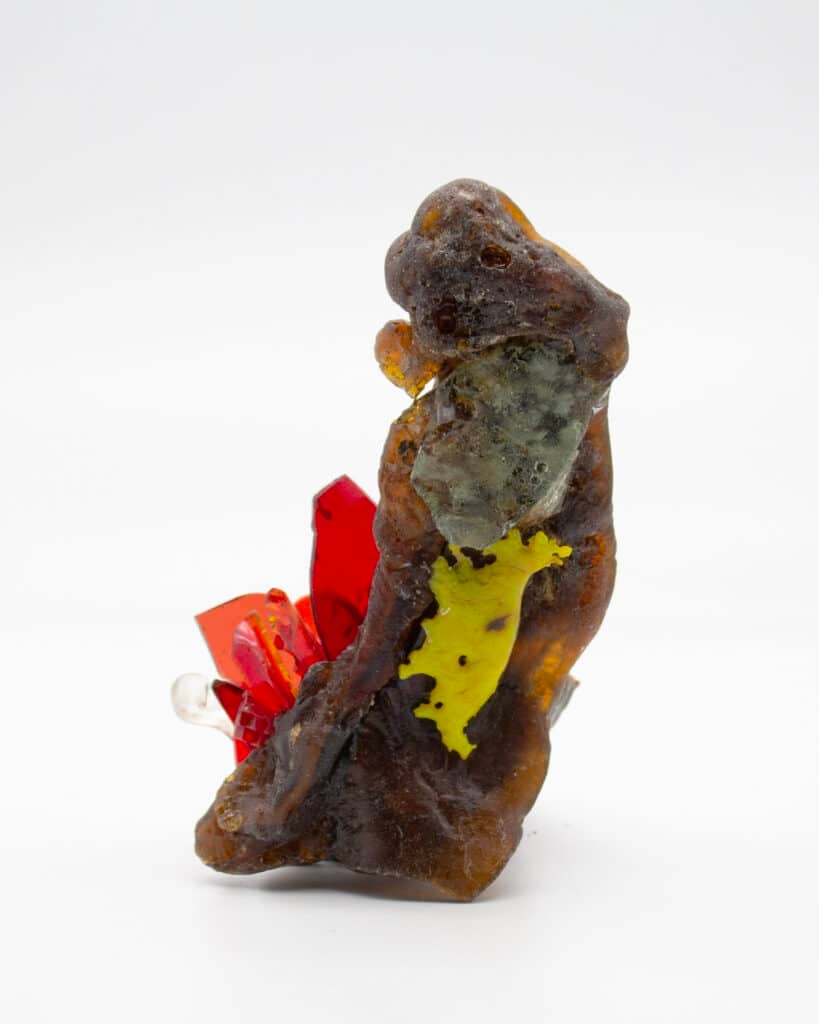
Of Shape Offshore
Offshore is framed as a liminal spatiotemporal condition where climate-driven erosion exhumes Dead Horse Bay’s buried animal remains, consumer detritus, and radioactive traces, turning the shoreline into a living archive of Anthropocene waste, mortality, and infrastructural violence. Through “paradoxical fossils” and a speculative cosmology, the work mobilizes new materialist and posthuman/queer ecological imaginaries—alchemical matter-knowledge osmosis, deep time, and trans-corporeal kinship—to propose world-making beyond human scale and linear history.
Read more
[ KADIST ]
[ KADIST ]
[ KADIST ]
Hercules Engines, Abandoned, Canton, Ohio
Architectural ruin photography is mobilized as social documentary, where the abandoned Hercules plant becomes a metonym for deindustrialization and the erosion of American manufacturing under military standardization and late-capitalist logistics.
Across Jones’s broader practice of appropriating and re-editing archival film, the work links material decay to mediated desire, tracing how queer identity, nostalgia, pornography, and fetish circulate as cultural images shaped by power and historical loss.
Read more

[ KADIST ]
[ e-flux ]
[ e-flux ]
Plan B
Postwar Beirut becomes a laboratory where architecture negotiates the ethics of memory, the seductions of ruin, and the violence of reconstruction, shifting from monumentality to tactical, often subterranean or disposable interventions that register absence rather than resolve it. Against the collapse of public space into privatized redevelopment, the work reframes entertainment, finance, speed, and code-driven envelopes as political media—critiquing façade-preservation, billboard urbanism, and Gulf-style imported modernity while proposing a contingent, locally generated modernity grounded in temporality, infrastructure, and urban DNA.
Read more
[ e-flux ]
Back to top