

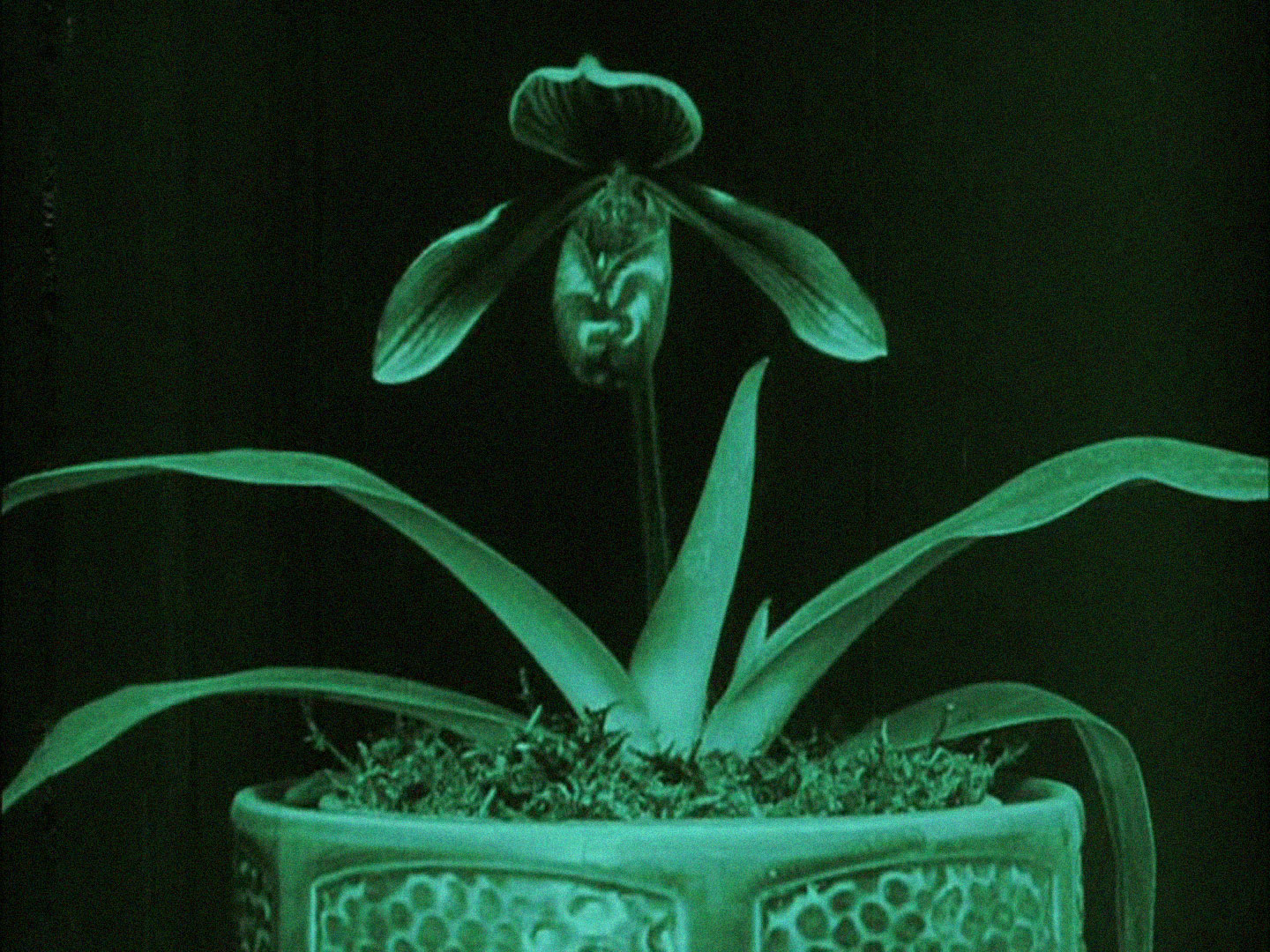
Filmstill from Max Reichmann's movie The Miracle of Flowers (1926).
A surprising animism is being reborn. We know now that we are surrounded by inhuman existences.
—Jean Epstein1Free up your mind … Help us re-imagine the world in richer terms that will allow us to find ourselves in dialogue with and limited by other species’ needs, other kinds of minds … The struggle to think differently, to remake our reductionist culture, is a basic survival project in our present context. I hope you will join it.
—Val Plumwood2
When I was a child, I was offered a book on forests. The book was filled with colorful illustrations: some were very intriguing, departing from the customary depiction of tree silhouettes and leaf shapes in which I otherwise reveled. Two images in particular caught my wandering eye. The first starred a houseplant resembling in every manner the philodendra that my mother had smartly arranged in our jungle-like living room. But instead of sitting quietly next to a velvet armchair, the book’s philodendron was connected to a strange-looking machine by two bulky electrodes. As the machine scribbled jagged lines on a strip of scrolling paper, a woman hiding a pair of scissors behind her back appeared to watch the plant closely. A second illustration depicted what appeared to my juvenile eyes as the cruelest of experiences: next to another potted plant, a man threw a sorrowful crayfish into boiling water. A living crayfish! According to the book’s author, those strange experiments proved that plants could both “experience fear” and “feel pain.”
Many years later, nurtured by a lifelong passion for both film and all things vegetal, I realized that the image of that leafy philodendron plugged into a lie detector accounted for much more than a wealth of wild, but incredibly popular, theses on the extrasensory perception of plants. At a time when our understanding of plant life and the vegetal world is being consistently and dramatically reshaped, when we’ve learned that orchids get jet lag too, the image of that wired plant begged both for a history of what I call the “mediated plant” and for a queering of botanics.3 As the crazy 1970s—with their foliage-heavy plants dropping from macramé hangers and plant-music vinyl records—have safely receded into the distant past, speaking of plant “awareness,” “thinking,” “consciousness,” or “intelligence” (nonequivalent but equally exhilarating terms for those engaged with post-humanism) no longer smacks of pseudoscience. The “sensitive,” “sentient,” or “intelligent” plant of our current time is necessarily a post-natural mediated plant, a plant interposed by visual and other technologies that make their awareness and in-tuneness with other plants and their surroundings discernible to the rationalist eye. These are technologies that invite us to conceive the plant-other in intentional and overtly queer terms; technologies, such as film, whose ultimate, paradoxical power has been, from its very beginning, the ability to re-enchant a disenchanted world, to enhance our perceptual possibilities and suggest alternative, counter-hegemonic ways of thinking about the world. That this decisive re-imaging of vegetal life has taken place beyond the respectful limits of serious science, in the dubious, murky waters of visual and popular culture, where the reality-producing dimensions of images and imagination run amok, should not come as a surprise. Albeit discontinuously, implicitly, or sometimes in frankly unusual manners, such images introduce imaginative fissures into the normative, Western narrative around human and nonhuman identities.
Such post-natural mediated plants are our queer kin, inviting us to abandon centuries-old conceptions of life and the living. As the mediated plant pushes us forward in this urgent “struggle to think differently” that Val Plumwood called us to join, mobilizing queerness means following a slightly defamiliarizing path. Indebted to ecofeminism and queer ecocriticism, this path will take us beyond the analytical category of gender and the battles of identity politics usually associated with queer theory. These battles, however, are not forgotten: as large swathes of the Amazon forest continue to burn (and as severe forest fires still rage in Siberia), queering nature and queering botanics represent a means of taking a political stance and of articulating our common struggles, which intersect now more than ever. The predatory industries that have declared war on the earth—razing and torching its forests, depleting its soils, killing its rivers, suffocating its oceans, factory-farming its animals, and exploiting its most deprived peoples—now form the economic rationality of right-wing populism and its hatred towards all minorities. As of today, nowhere is this more visible than in Brazil, where the agribusiness attack on the forest goes hand in hand with the brutal assault on indigenous and LGBT rights and where the country’s poor and black communities (with women on the front lines) face unprecedented threats. But extractive capitalism takes its toll everywhere, and environmental breakdown is here to stay. To survive and resist means to adjust, to leave behind reductive stances, and to wrench ourselves loose from our monological, colonizing grip on “nature.” Forests are not stocks of natural resources (even if they’re sustainably explored), nor are they the “lungs of the earth.” Forests are life-forms and forms of life, from whom we must learn and with whom we need to forge alliances. We need to rebel against the deep-rooted, dualistic conceptions that have radically separated us from nature and more-than-human others. Ultimately, we need to rebel against ourselves: maybe the mediated, sentient, intelligent plant can help us to queer ourselves-as-humans, as we either, as Plumwood declared, “go onwards in a different mode of humanity, or not at all.”4
Slowly Undoing Anthropocentrism: Seeing Plants Move (and Putting Them to Sleep)
Since at least the 1980s, the animal turn, propelled by the animal rights movement, has systematically put the question of animal difference, agency, conscience, and subjectivity on the agendas of the humanities and social sciences.5 Now a “plant turn” seems to be sweeping different fields of knowledge and creation. As the human species sleepwalks into a greenhouse fever of its own making, plants and their singular life forms, long relegated to the margins of conceptual thinking about life itself, finally jut out of the leafy, decorative setting in which they had been “backgrounded,” in order to be better acted upon.6 Books on the “hidden life of trees” become worldwide best sellers and pioneering countries buck the general deforestation trend by granting legal personhood to forests.7 As botanists and geneticists lose their exclusive grip on the puzzles of vegetal life, philosophers invite us to think about and with plants, reclaiming a noninstrumental approach to plant life and taking plants’ relational and nonhierarchical mode of being as an ethical and political model.8 In the meantime, artists dream of chlorophyll–blood hybrids and bio-hack genetically engineered carnations.9 Anthropology decenters itself, opening up to the joys of sylvan thought and to the foraging of rare mushrooms.10 On biology’s side, if the idea of a “plant neurobiology” continues to raise eyebrows (plants don’t have brains or neurons), the notion that plants are complex, sensate, aware beings capable of communicating and of feeling for others has gradually imposed itself on the view that plants are less complex life forms, in particular when compared to “superior animals.”11 If most scientists will still refute the notion of plant intelligence, contemporary biology seems to have opened up to the idea that plants (and more generally “nature”) evince at least a “capacity to know,” which anthropologist Jeremy Narby equates with the Japanese notion of chi-sei, a “knowing-ness,” a “recognizing-ness.”12
In a way, the extremely different approaches that I’ve crudely sketched echo, without necessary epitomizing, a much larger, urgent enterprise: that of sidestepping the tenants of modern thought and of challenging the exclusiveness of both knowing and feeling as human attributes. Whether or not their contributors acknowledge it (or even desire it), current debates on plant life border on what Brazilian anthropologist Eduardo Viveiros de Castro has called the “decolonization of thought,” on the undermining (and, one hopes, eventual overturning) of old conceptual and metaphysical schemes (nature and culture, human and nonhuman, subject and object, etc.). Writing on Amazonian thought (whose relation to plants and the living world is radically different from ours13), Viveiros de Castro makes it clear that to decolonize means here a “permanent” effort to challenge and to destabilize the hierarchical relationships between “our” thought and “other’s thoughts.” In this sense, “there can be no definitive decolonization, because thinking itself is a sort of colonization.”14 In any case, to acknowledge the richness and complexity of plant life (to put it mildly) means here to withdraw (albeit slowly) from a anthropocentric, colonizing reason that has not only separated humans from “nature” in order to justify its domination, situating human life outside and above it, but which has also organized the world according to gender and racial hierarchies, equating women, indigenous, and nonwhite people with the “primitive.”
In this flourishing context, the study of plant motion continues to progress, thanks to “new in vivo imaging techniques.”15 Beyond the stories of cyborgish houseplants posting info regarding their “state of mind” on blogs,16 the mediated plant shows itself in all its negotiated glory when we look into historical research on plant movement and sensitivity. As plants’ apparent immobility was a favored old Aristotelian argument against the worth of their (inferior, vegetative) souls, the proliferation of studies on plant motion and plant physiology during the second half of the nineteenth century mark a significant turn toward the retrospectively surprising troubling of one of modernity’s sacred cows: human exceptionalism. Obviously, it had been known for centuries that plants move, and not only under the influence of the wind, or due to growing and seasonal cycles. The spectacular examples of the Mimosa pudica (also known as the “sensitive” plant, or “touch-me-not”), whose leaves quickly fold inwards at the slightest shock (and which seems to remember and to organize learned behavioral responses17, or of the legendary Dionaea muscipula, the uncanny and animalesque “Venus flytrap” whose carnivorous appetite defied Linnaeus’s taxonomy, demonstrated this well. Indeed, such plants haunted the botanical imagination of the time. Despite this, the sheer amplitude of plant movements remained largely unknown then, as well as their links to a multitude of external stimuli (light, temperature, gravity, mechanical pressure, etc.). Moreover, Western botanical science remained arrogantly ignorant of much more ancient, indigenous bodies of knowledge on plant life and more-than-human sentience—a liability since settled by several indigenous, female scientists such as Wendy Djinn Geniusz and Robin Wall Kimmerer.18
Toward the end of the nineteenth century, scientists started using a plethora of motion analysis devices, such as graphic tracing techniques and eventually time-lapse cinematography, in order to demonstrate that apparently inert plants could move, “sleep,” and were sensitive. Before cinema brought its own spectacular answers to the study of plant motion, manipulating scale and reconciling the dissonant temporalities of human and vegetal beings, revealing the full extent of “the non-conscious intentionality of vegetal life,”19 it was the graphic method, more than photography, which confirmed that plants are indeed the active agents of their own fate. Taking part in the unprecedented broadening of the visible world in which photographic technologies were to excel, the graphic method, from which lie detectors developed, detected what positivist science regarded as “truths about nature”: the laws governing physiological processes, from blood (or sap) flows to human (or animal and plant) movements. According to the positivist credo, translating these “laws” and “truths” into a fantasized, nonverbal, iconic language—the language of diagrams and mathematical formulas—via “self-recording instruments” allowed for the understanding and, ultimately, the (relative) control of plant movements.
As expected from any good physiologist of the time, the French doctor Paul Bert illustrated his 1867 work on the Mimosa pudica with graphs that render the sensitive oscillation of movements both visible and measurable—in particular when Bert thrillingly puts the plant “to sleep,” using a sponge soaked in ether.20 All over Europe, men of science rushed to chloroform and to administrate various narcotics to plants, musing on their “nerves” and “irritability.”21 For the highly influential The Power of Movement in Plants, Charles and his son Francis Darwin generated a plethora of images, conceived with ingenious devices involving smoked glass plates and beads of wax on glass needles. In short, the graphic method, famously promoted by Étienne-Jules Marey, was put at the service of botany. Darwin was so impressed by the results that he concluded in his book that the tip of a plant’s radicle resembled an animal brain, opening the door for plant–animal analogies and igniting the debate on plant intelligence.22 From Bert’s and Darwin’s tracings to Jagadish Chandra Bose’s plant autographs, these images potentially effected (despite the original agendas of some of their makers) variable shades of biocentrism, paving the way for a new consideration of plant life. This cue was initially followed by a number of (neo)vitalist philosophers and biologists who, in particular in Central Europe, adamantly opposed dominant mechanistic views throughout the early twentieth century. These philosophers and biologists included Raoul Heinrich Francé (see below), Max Scheler, and Ludwig Klages.23
Beyond its documentary use, the images produced according to the graphic method—quickly backed by film24—have a heuristic power, anticipating novel ideas through and thanks to images.25 Among these, what we could call the plants’ “becoming subject” is perhaps the most striking, in particular when it comes to film. As a matter of course, these images negotiate a transition from the statute of object to that of subject—what is more, an intentional subject. Again, this is particularly evident when it comes to film, with cinema providing a surprisingly generous framework for the other-than-human. Film is able to overturn the basic subject–object dualism, rearranging the frontiers of the living, extending intentionality to a multitude of nonhuman subjects, sensing other sentience, and exposing (and suggesting) different modes of being alive. This is all the more astonishing as moving pictures were presented as the celebrated champions of “mechanical objectivity,” the ultimate means of capturing and possessing the world. But as film critics and theoreticians remarked very early on, cinema seemed to be “animism’s chief apostle.”26 Indeed, it’s as if film images reawakened other ways of seeing. Instead of disenchanting the world, cinema “re-enchanted” it, by imputing interiorities to animals, plants, objects, weather phenomena, machines. Moreover, and this was another topos of film theory and criticism between the 1910s and the 1950s, cinema invites the spectator, a modern subject par excellence, to connect with “other ways of thinking.” In other words, cinema might be the child of scientific and technological modernity, but it reminds us that we have never been totally modern.
Among the champions of cinema’s animism, French filmmaker Jean Epstein draws some of the more interesting conclusions. As he writes in 1935, with regards to time-lapse cinematography, “Slow motion and fast motion reveal a world where the kingdoms of nature know no boundaries. Everything lives.” And, he adds:
A surprising animism is being reborn. We know now, because we have seen them, that we are surrounded by inhuman existences … The cinematographer extends the range of our senses, making perceptible to our sight and to our hearing individuals that we considered invisible and inaudible.27
Evoking a documentary film on the life and death of a plant, a picture condensing one year of growth and withering into a few minutes, he suggestively remarks that such film “accomplishes for us the most extraordinary journey, the most difficult escape that man has yet attempted”28—an escape from our own (human-)centrism. The stakes of this escape evoke Plumwood’s call to distance ourselves from the self-enclosing centrisms proper to Cartesianism as we “go onwards in a different mode of humanity, or not at all.” Obviously, Epstein did not have the ecological crisis of reason in mind when he wrote this: he hints convincingly at film’s capacity to suggest an alternative framework to anthropocentrism, in particular when the mediated plant is involved. In Epstein’s time, the apparent risk was to fall prey to a disregarded, romantic form of neovitalism, illustrated, among others things, by the texts of Austro-Hungarian botanist and philosopher Raoul Heinrich Francé. As Francé writes in Das Sinnesleben der Pflanzen (The Sensory Life of Plants, 1907):
The modern naturalist can no longer narrowly limit himself to the study of plants or animals, because life, in its many aspects, solves the problem in a practical way, however varied it may be, and refutes our artificial separations and our classifications between plants, animals and men.29
Even worse, filmic images indulge in that regressive, animistic vice that zoomorphizes and anthropomorphizes plants, forever doomed to the lower echelons of life. Because of their suggestiveness, of their hold over primitive and childlike spectators in front of the film screen (as many authors believed in the early twentieth century), they were much more dangerous than the sober graphs and charts of the graphic method. As French writer Colette wrote in 1924, making evident cinema’s perilous empathetic, emotional powers:
A time-lapse film documented the germination of a bean … At the revelation of the intentional and intelligent movement of the plant, I saw children get up, imitate the extraordinary ascent of the plant climbing in a spiral, avoiding an obstacle, groping over its trellis: “It’s looking for something! It’s looking for something!” cried a little boy, profoundly affected. He dreamt of a plant that night, and so did I.30
But don’t time-lapse films on plant motion simply illustrate a way of anthropomorphizing nature and plants? Doesn’t all this culminate, film-wise, in Disney’s “Silly Symphonies”— playful but definite misrepresentations of other-than-human beings? When a voice-over in a British Pathé production from the “Secrets of Nature” series cheekily proclaims that “some plants are born-criminals” and that the dodder in the film has “no intention of earning a respectable living,” aren’t we right to ask this question?31 Don’t these pictures exemplify a misguided and insufficiently critical reasoning, a thought that attributes human predicates to other-than-human subjects? Isn’t their undermining of anthropocentrism fundamentally flawed by anthropomorphism?
The answer is not simple. We should first distinguish anthropocentrism from anthropomorphism. That the gradual reversal of the first relies, sometimes, on a form of anthropomorphism is not, in itself, a contradiction, as the “policeman for reductive materialism” would like us to believe, whose mission is to enforce “polarised and segregated vocabularies for human and nonhuman.”32 Indeed, as philosophers, etiologists, and anthropologists have repeatedly pointed out, the rejection of anthropomorphism, conceived as a vice of reason since the Enlightenment, stems from an ontological assumption peculiar to modern thought. It was the radical separation between “Man” and “Nature” that banished anthropomorphism to the barely accepted limits of reason and reduced it to a cognition problem common to children and “primitive peoples.” Understood as a form of “generous sociality” (and otherwise unknown to Neanderthals), it was anthropomorphism, however, “that made us humans,” at least according to French ethnologists Aude Michelet and Charles Stépanoff.33
In our current context, we should be wary of all forms of anthropocentrism, as in our Western context they seem to promote human remoteness from the living world, holding an aloof, escapist “anthropos” in his crumbling ivory tower. But as we endorse more caring, communicative, and attentive attitudes towards the earth and our other-than-human counterparts, maybe a critical and creative anthropomorphism is not only possible, but desirable, as a necessary step. As opposed to a “patronising and difference-denying”34 anthropomorphism, this creative anthropomorphism can be a way of apprehending the diversity and alterity of life and the living, and a means of becoming otherly human. In many ways, to undo anthropocentrism is to decolonize thought: although again, as Viveiros de Castro reminds us, we cannot totally fulfill this mission. Maybe animistic anthropomorphism is a reasonable price to pay: “People tend to think that animism is a narcissistic, anthropomorphic, anthropocentric fantasy of primitive people, children, and madmen,” says Viveiros de Castro, “when actually animism is exactly the opposite. If you say that everything is human, then you also must say that humans aren’t special, because everything is like us.”35 It turns out that film (albeit not The Strangler, Disney’s Flowers and Trees, or even the Swamp Thing—“a plant that thinks it’s human”36) is sometimes the place where this critical anthropomorphism, envisaged as an invitation addressed by images to their human spectators, can take place. As anthropologist Natasha Myers justly observes, we need to reconsider animism (among other things an essential feature of film) and anthropomorphism since,
the very taboos against [them] are grounded in colonial imaginations of nature and culture, and … this disavowal of nonhuman sentience is intimately bound up in colonial projects that have taken shape under the guise of the ecological sciences.37
In other words: free your mind.
The Filmic Life of Plants
In 1966, a polygraph expert working for the CIA hooked up one of his machines to the leaf of a dracaena. As Michael Pollan writes, “To his astonishment, Cleve Backster found that simply by imagining the plant being set on fire he could make it rouse the needle of a polygraph machine, registering a surge of electrical activity suggesting that the plant felt stress.”38 In the years to come, Backster and his collaborators multiplied the experiments, plugging dozens of plants and vegetables into lie detectors and concluding that lettuce, onions, and a multitude of inconspicuous houseplants could perceive and respond to human thoughts and emotions. In 1979, when a botanist and physiologist painstakingly attempted to explain, in the pages of American Scientist, that Backster’s experiments were anything but serious science, the damage was already done: the thesis on plants’ extrasensory perception and their astounding emotional capacities had quickly spread worldwide.39
In 1973, Peter Tompkins and Christopher Bird’s bestseller, The Secret Life of Plants, mainstreamed Backster’s findings and rediscovered a number of forgotten “plant-intelligence” champions, such as the Bengali biologist and polymath Jagadish Chandra Bose, and the African-American agronomist, experimenter, and pioneering environmentalist George Washington Carver. Leaving a considerable imprint on both popular and visual culture, The Secret Life of Plants—along with Dorothy Retallack’s The Sound of Music and Plants (1973)40—made it normal to play classical music to houseplants and inspired a number of records, films, and writings, including my childhood book on forests. Taking advantage of the volume’s worldwide success, Paramount adapted it for the screen in 1978: directed by Walon Green, The Secret Life of Plants included an original soundtrack by none other than Stevie Wonder. Released a year later as a double LP, Journey Through the Secret Life of Plants constitutes an original addition to the list of records professing that plants react favorably to music ; it’s also the only record I know that includes a song on the skepticism raised by botanical scientific discoveries.41 As for cinema, the allusions to Tompkins and Bird’s bestseller pop up here and there, as in Philipp Kaufmann’s Invasion of the Body Snatchers (1979), where not only space invaders resemble unemotional vegetal pods, but where plants are played classical music in a mud-bath parlor by an attentive carer. The same year, a thriller directed by Jonathan Sarno, The Kirlian Witness (rereleased recently under the title The Plants are Watching), goes a step further, telling the story of a woman who attempts to telepathically communicate with a plant in order to find out who murdered her plant-loving sister.
As The Secret Life of Plants makes an expected comeback today, two things come to mind with regard to the plant madness that struck the 1970s.42 Firstly, the historical context in which these theses circulated and spread was significant; among other things, it included the rise of New Age thinking, which was rooted in the American counterculture of the sixties, and which became, in the seventies, more and more oriented toward a form of “mystical ecology.” Secondly, when The Secret Life of Plants came out, Cold War hysteria had not yet ended (did it ever?). As a matter of course—and this should also be kept in mind when considering a number of sci-fi films from the fifties and sixties where plants assume uncanny contours (turning out most of the time to be carnivorous and to take great pleasure in gobbling women’s flesh43)—the ideological conflict that opposed the US to the USSR (and with it the rest of the world) also took place in research labs. Scientific teams devoted themselves to the study of strange phenomena, ranging, in the case of plant science, from the feasibility of growing plants without sunlight to the possibility of “biological communication”44 between humans–animals–plants in order to “cybernetically … direct all the physiological processes of plants.”45 Backster’s theses were taken seriously on the other side of the Iron Curtain: as Tomkins and Bird recall in their book, the Soviets had a well-established research tradition concerning plant communication, as evidenced by two soviet documentaries promoting the breakthroughs of Communist science: The Voice of Plants (1968) and Do Plants Feel? (1970).
Indeed, images played an essential and versatile role in the mainstreaming of the plant sentience hypothesis. Even the images produced by Backster’s polygraph have a heuristic power. As we can see in The Secret Life of Plants, or in Do Plants Feel?, regardless of their scientificity the scribbling lines methodically inscribed by tiny needles on strips of scrolling paper open up theoretical horizons concerning plant’s potential “agency,” “awareness,” “conscience,” “intelligence,” “intentionality,” “sentience,” or “thinking.” Moreover, plant sentience and intelligence are now explicitly associated with the mediation of machines. Again, the sentient plant is a mediated plant: a plant mediated by polygraphs and their electrode cables; a plant mediated by Kirlian or “aura” photography (the collection of photographic techniques which inspired Sarno’s thriller); a plant mediated by the apparatus that Mr. Hashimoto conceived so that one could hear the voice of a cactus to whom his wife, Mrs. Hashimoto, had taught the Japanese alphabet46; a plant mediated, again and again, by time-lapse cinematography, which exposes, according to the voice-over in Paramount’s film adaptation of The Secret Life of Plants, “the pain and the joy” expressed by and in plant motion. In fact, the sentient plant of the 1970s is still a plant that can be seen to move.
In the early twentieth century, critics and filmmakers marveled before scientific (and other) films that were capable of exposing, by virtue of cinema’s expressive resources (time lapse, the close-up, editing, etc.), the secret life of plants. Tender shoots pierced the ground in seconds, stems feverishly burst toward the light, and flowers bloomed in the blink of an eye. The bindweed danced, the passionflower moved, and the medeola virginiana twirled: in other words, plants had become animated, joining the army of inhuman existences that Epstein recognized on screen. These films, from Die Seele der Pflanze (The Soul of Plants, unknown filmmaker, 1921) to The Movement of Plants (Jean Comandon, 1929), seemed to resuscitate what botanical herbaria dried and flattened between their yellowish sheets of paper. They escaped the taxidermic paradigm that characterized ethnographic and wildlife films from the early twentieth century, in their murderous conservationist impulse.47 Whether in France or in Germany, the wonderful spectacle of these films appeared as a revelation, confirming the heuristic capacities of filmic images. These disclosed not only the autonomous movements of plants, but also their expressiveness, which some, like botanist Raoul Heinrich Francé, believed to constitute the manifestation of a primitive intelligence. One film in particular, The Miracle of Flowers (1926), elevated plant motion to the status of expressive gesture.
Shot in Germany by Max Reichmann, this singular feature film was sponsored by the chemical corporation BASF in order to promote nitrate fertilizers—fertilizers using the same nitrogen compounds that were massively used during the First World War to produce bombs and bullets, that turned Chile’s Atacama desert into a desolate battleground, and that are now an authorized method of execution in three American states.48 The Miracle of Flowers tells the story of a fairy named Flora who, having surprised a group of children carelessly plucking “innocent” living beings (i.e., flowers), acquaints them, thanks to time-lapse images documenting the growth and withering of seventy-eight plant species, with the “sorrows” and “struggles” of plants, “the rhythm of their movements,” their “feelings.” The film’s originality lies in the images that Reichmann intercuts with the time-lapse sequences: expressionist dance scenes, where human dancers interpret and mimic the gestures of plants. The performers in question belong to the Berlin State Ballet: directed by choreographer Max Terpin, they illustrate the guiding principles of Ausdruckstanz, the expressionist dance movement that developed in Germany from 1910 onwards. As Matthew Vollgraff recalls, the film made a strong impression in Germany, touching film critics and philosophers alike, including Theodor Lessing and Max Scheler; the latter observes in a personal letter that he had seen “flowers breathe, bloom and die. The idea that plants had no soul disappeared completely.”49
Perhaps The Miracle of Flowers is yet another example of cinema’s shameless but inventive anthropomorphism: the attribution of human motivation, characteristics, and behavior to inanimate objects, animals, plants, and natural phenomena. In this sense, the film would not challenge but instead reinforce an anthropocentric vision of the world, whereby every form of life is modeled on human selves and personhoods and submitted to anthropocentric measures and perspectives. It is true that The Miracle of Flowers, like most time-lapse plant films from its time, falls prey to anthropomorphic analogies; still, the picture’s treatment of temporal scale also introduces some interesting shifts. This is most evident when Flora, after explaining to the children that they “don’t notice their [the flowers’] sorrows and struggles, because the rhythm of their movement operates under a different time measurement, and yet like you they flower and fade,” grabs a girl’s wrist to take her pulse. The film cuts to micro-cinematographic images of human blood, which render the human body surprisingly uncanny. As an intertitle explains, a pulse beat equals a human second; soon after, a mechanical clock starts to race, disrupting human rhythms and compressing four years of growth into one hour of screen time. In other words, the technological wonder of time lapse accomplishes the miracle of relativizing human life-rhythms. By making other rhythms of life visible, film—through the mediation of a machinic, other-than-human subject, the camera—is potentially allowing the human spectator to recalibrate her anthropocentric perspective and to open herself to other-than-human subjectivities—such as that of the camera, or those of plants.
Queering Botanics
The mediated, sentient, and intelligent plant potentially invites us to think about nature, plants, technology, and ourselves-as-humans in different ways. As plants in particular are revealed as agentic, intentional beings, the mediated plant potentially invites us to develop more caring, attentive, and communicative attitudes toward the vegetal. In this way, the mediated plant can push us forward in the urgent “struggle to think differently” that Plumwood called us to join. Perhaps the mediated, sentient, intelligent plant can help us to queer nature, to queer botanics, to queer ourselves-as-humans as we “go onwards in a different mode of humanity.”50 But why to queer? Why not “simply” to “decolonize”?
Because queer has never been only human. Because queer can be a way to reimagine what it means to be “human” in the age of man-made ecological catastrophe, as we estrange ourselves from dualistic identities and an oppressive mode of being human. Because queer is a means to push forward the boundaries of our thinking about ourselves in relation to all the meaningful others who share the world with us. Because queer is about identity and inclusion.
Much in the manner of feminist theory, whose hermeneutic tradition goes far beyond the category of “gender,” queer theory can be shifted (and has been shifted, as queer ecocriticism demonstrates) to the grounds where the human and the other-than-human encounter and experience one another. Engaging with queer theory in this context means putting an accent on problems of boundary formation and negotiation pertaining to the “human as norm.” Haunted by the regulatory notions of “natural” and unnatural,” queer theory has constantly wrestled with the culturally constructed dimension of what we understand the “natural” and “nature” to be. Queer theory can help us to radically rethink identities, who and what we are, who and what we can become.
To uncenter “gender” doesn’t mean to ignore it. As imagined by our naturalist ontology, nature is all about gender. The science of botany in particular provides us with an excellent example of the overwhelming strength of binary thought, as plant sexuality became, from the eighteenth century onwards, a battleground over the gendering of nature, knowledge, and the social order. As artist Pedro Neves Marques rightfully recalls in Linnaeus and the Terminator Seed, a 2017 film-essay connecting modern botany to contemporary transgenics, Swedish botanist Carl Linnaeus “made gender and sex the founding principles of nature.” Having established “maleness” and “femaleness” as the basis of the classification of plants, Linnaeus not only turned the sexualization of nature into the basis of his Systema Naturae (1735), therefore conflating vegetal and human reproduction, but he gendered nature, metamorphosing plants into green homunculi trapped inside a highly patriarchal structure. Using the number of (male) stamens and (female) pistils in a given plant to determine the class and the order to which it belonged, Linnaeus went on to categorize the vegetal kingdom according to the “public” or “clandestine marriages” of its subjects (i.e., the visible or less visible arrangement of sexual organs in the flower). His imaginative descriptions are filled with what many decried as licentious, obscene metaphors: “marriages” implying sometimes more than twenty “husbands” (male stamens) sharing the same “bed” or “house,” the female pistils caught up in such devious arrangements being described as meretrices or concubinae. Transgression was kept within close heteronormative boundaries: the hermaphroditic self-fertilization of plants was conceived as yet another form of heterosexual conjugality.
Beyond gender(ing), to queer botanics is to recognize plant nature is queer nature. A queer nature made of peculiar, twofold bodies: an aerial body that grows upwards and reaches for the light, and a subterranean body that pushes through the soil and recedes into the darkness. It is a nature based on autotroph lifestyles: unlike fungi, animals, or humans, plants do not (usually) feed on others. They produce their own nourishment, trapping energy from sunlight, processing carbon dioxide and water; even carnivorous plants can live and grow without digesting insects. Plants are not only mediated: they are the great mediators of our world, transforming solar energy into living matter, producing an oxygen-rich atmosphere. Even when rooted in contaminated soils, growing in human-disturbed environments, or when genetically modified, plants make our world possible. As philosopher Emanuele Coccia would put it: plants are our gardeners.
Beyond gender(ing), to queer ourselves-as-humans is to make a step toward becoming other. Not to become plant, but to become otherly human, as the post-natural mediated plant is otherly plant.