

A new way to explore
contemporary art and ideas
How does art expose structural violence?
Works reveal forms of harm embedded in institutions, policies, and everyday systems.
[ e-flux ]
[ e-flux ]
Reading Art as Confrontation
Anticolonial art is theorized as a “corruption” of aesthetic form that turns presentation into confrontation, refusing representation by making violence and intimacy visible without rendering them public or consumable as evidence. By collapsing the presumed universality underwriting the public sphere and Kantian judgment, performance exposes spectatorship’s ethical closure and the art institution’s complicity in epistemic violence, pushing postcolonial critique beyond denunciation toward an embodied dismantling of modernity’s representational grammar.
Read more

[ e-flux ]
[ KADIST ]
[ KADIST ]
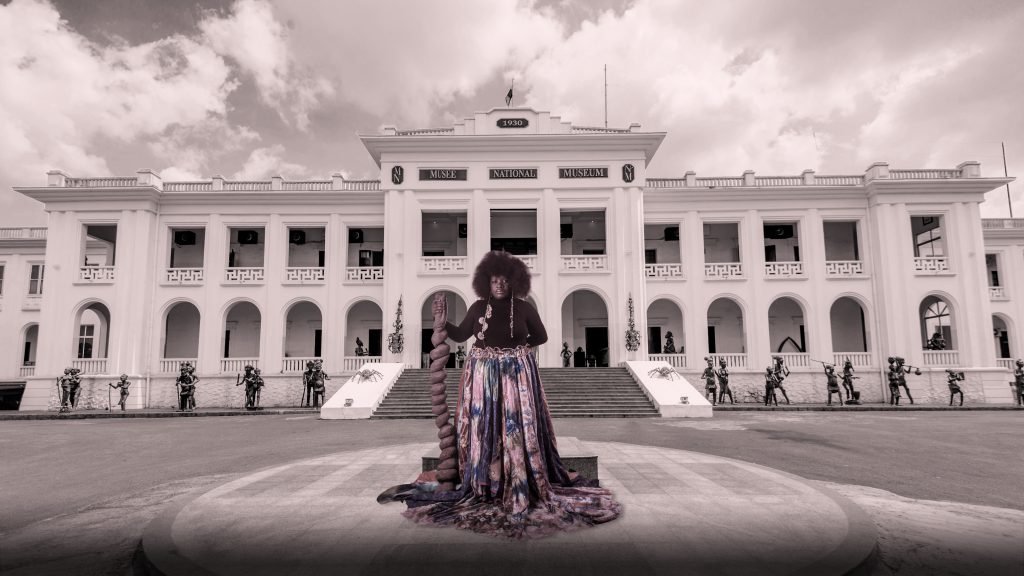
Musée colonial (série "Au non de la liberté (Tiko drink Kumba drunk)")
Performative self-insertion before colonial-era administrative architectures stages the body as a counter-monument, exposing how postcolonial sovereignty reproduces colonial power through lawlessness, curtailed civil liberties, and the unequal distribution of political consequence (“Tiko drink–Kumba drunk”).
By mobilizing formal color contrasts and site-specific protest imagery, the series frames photography as civic action and decolonial critique, seeking a rebalanced social contract between citizens and authority through visibility, alternance, and collective accountability.
Read more
[ KADIST ]
[ KADIST ]
[ KADIST ]
Masterpiece in the Water
A murder staged as an artwork collapses ethical violence into aesthetic production, using war anxiety, kinship, and the paranormal to expose how the art world metabolizes trauma, superstition, and imagination as survival technologies. Minimal, site-responsive story-display foregrounds contemporary tensions between materiality and immateriality and between narrative and visual form, aligning fantasy with institutional critique and the demystification/remystification of artistic authorship.
Read more

[ KADIST ]
[ e-flux ]
[ e-flux ]
Walkthrough, Part I
Stages the art market as a risk-managed, data-mined apparatus in which artworks become derivatives and artists are pooled into actuarial collectivities, exposing how value is engineered through contracts, curatorial “intelligence,” and algorithmic prediction rather than aesthetic judgment. By threading geopolitical anxiety (Israel/Lebanon, military-intelligence lineages) through corporate opacity and post-9/11 opportunism, the narrative critiques the banal normalization of finance–security–culture entanglement and questions whether revealing these infrastructures still constitutes a meaningful critical artwork.
Read more
[ e-flux ]
Back to top