

A new way to explore
contemporary art and ideas
How do myths evolve in the digital age?
Contemporary works remix folklore, internet culture, and speculative fiction to create new mythologies for unsettled times.
[ KADIST ]
[ KADIST ]
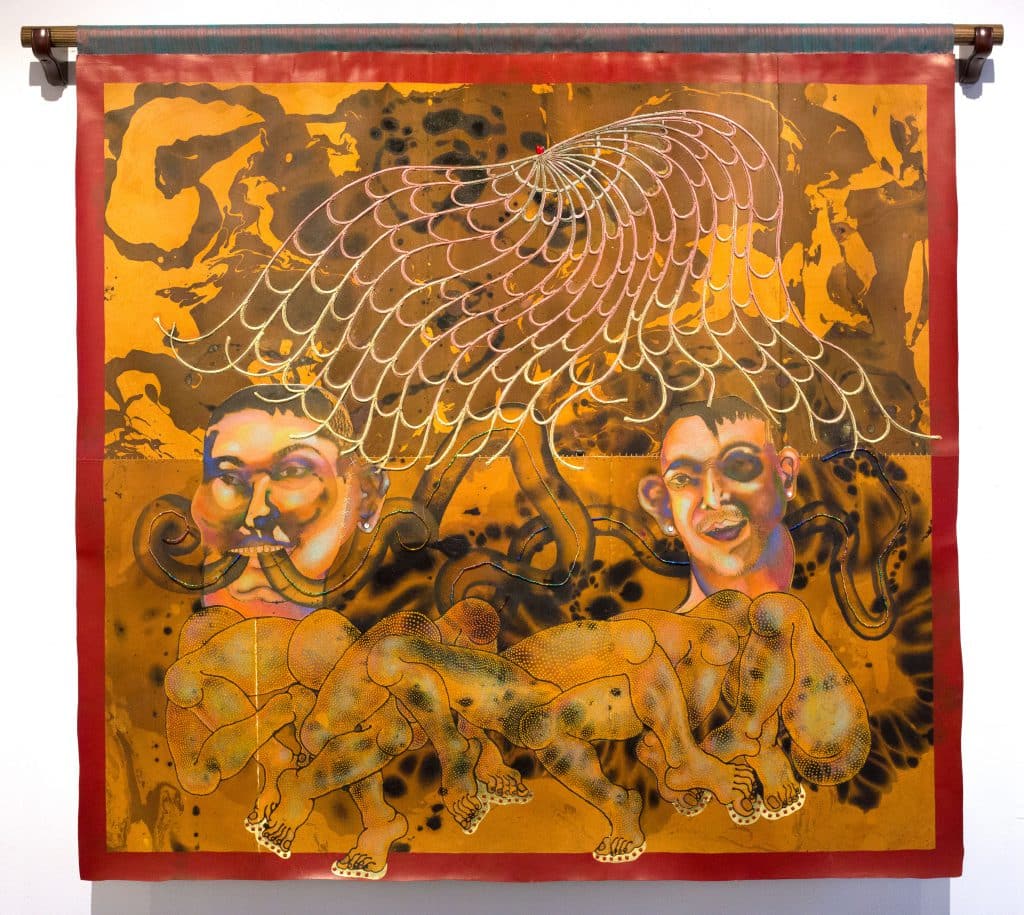
Austintipede
Myth functions as a trans-cultural, pop-inflected narrative armature through which Ramakrishnan stages identity, sexuality, and gender as unstable, violently produced formations, reworking traditionally masculine symbolic systems from a metamorphic feminist position.
Her accumulative, abject material practice—rooted in social relations and found substances with embedded “secret narratives”—mobilizes a postmodern bricolage and embodied indexicality to move viewers between visceral matter and a transcendent field of signification and narrative play.
Read more
[ KADIST ]
[ e-flux ]
[ e-flux ]
Le Nemesiache: Erupting Feminist Cosmologies
Myth and poesis are mobilized as feminist technologies of interruption that undo the “Ordered World” of separability, linear time, and bourgeois hetero-patriarchal reason, reframing Medea’s irreconcilable cosmologies as a critique of capitalist enclosure and North/South modernity.
Le Nemesiache’s interdisciplinary praxis—psycho-fables, occupations, counter-festivals, and sibylline/amazonian figures—conjoins embodied memory, ecology, and transfeminist metamorphosis to “disenclose” suppressed knowledges and invent a new common metaphysics where art and political life co-produce planetary, nonbinary futures.
Read more

[ e-flux ]
[ e-flux ]
[ e-flux ]
Religion in the Age of Digital Reproduction
Religious resurgence is framed as an evolutionary success within a media ecology dominated by repetition, where the Internet privatizes the political and privileges sovereign “freedom of faith” (ritual, commitment beyond justification) over institutional, evidentiary discourse associated with science and liberal-democratic deliberation. Fundamentalism appears as a post-Enlightenment, post-deconstructive politics of the letter—literal repetition aligned with reproduction—while digital video recasts revelation as the staged visualization of invisible code, making identity/originality a matter of belief and offering a technical, immanent model of immortality via endlessly repeatable loops.
Read more
[ e-flux ]
[ KADIST ]
[ KADIST ]
Untitled
Verifax-based repetition and appropriation (the hand-with-radio motif) mobilize Beat-era assemblage strategies to stage a meditation on mechanical reproduction, media ubiquity, and the way mass imagery scripts consciousness like a filmic sequence.
By inserting pop, religious, and esoteric symbols into the radio’s frame, the work collapses sacred/profane and private/public registers into a cryptic, viewer-decoded semiotic field that doubles as West Coast countercultural critique.
Read more

[ KADIST ]
Back to top