

A new way to explore
contemporary art and ideas
[ KADIST ]
[ KADIST ]
Readymade Flea Market
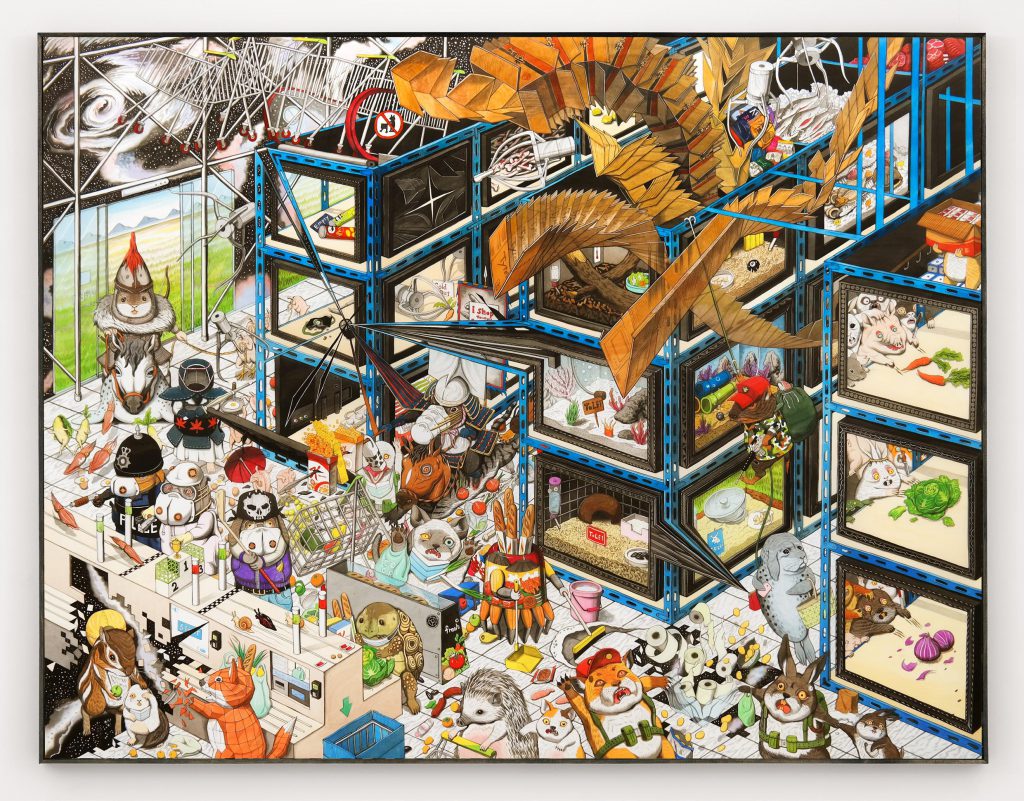
A simulated “ancestor” reality—framed through Bostrom-style world-simulation theory and rendered as a collapsing 3D graphic space—becomes an allegory for post-liberal political nihilism and the systemic overheating of late-capitalist economies. Anthropomorphic panic-buyers, empty shelves mediated by televisions, and Kruger’s consumerist dictum converge with Korean silk-painting lineage to critique information-age spectacle, neoliberal subject formation, and an eternalized state of emergency where violence and commodity-fetishism appear as normalized social logics.
Read more
[ KADIST ]
[ e-flux ]
[ e-flux ]
Styles and Customs in the 2020s
Speculative vignettes stage the 2020s as an accelerationist collapse of modern distinctions—public/private, art/life, human/tech—where platform capitalism, data extraction, and privatization reorganize subjectivity into quantified affect, curated identity, and engineered desire amid ecological crisis.
Post-ironic lifestyle aesthetics, Afrofuturist and queer biohacker counter-myths, and the end of authorship/appropriation converge into a critique of neoliberal governance and microfascist “props,” imagining culture as distributed operations and curation-as-power while exposing utopian freedom as a managed, content-producing enclosure.
Read more

[ e-flux ]
[ e-flux ]
[ e-flux ]
Notes on the Inorganic, Part I: Accelerations
Capitalism is figured as an inhuman, ecophagic process whose imperative of infinite growth structurally entails depletion, extinction, and a drift toward the inorganic—allegorized through nanotechnology’s “grey goo” as a fantasy-form that displaces already-active eliminations. Against pragmatic “pre-emptive design” that normalizes post-extraction ruin, the text probes accelerationist aesthetics as a risky tactic: intensifying capital’s dissipative logic to induce glitches, mutations, and new critical morphologies beyond anthropocentric frameworks.
Read more
[ e-flux ]
[ KADIST ]
[ KADIST ]
True Red
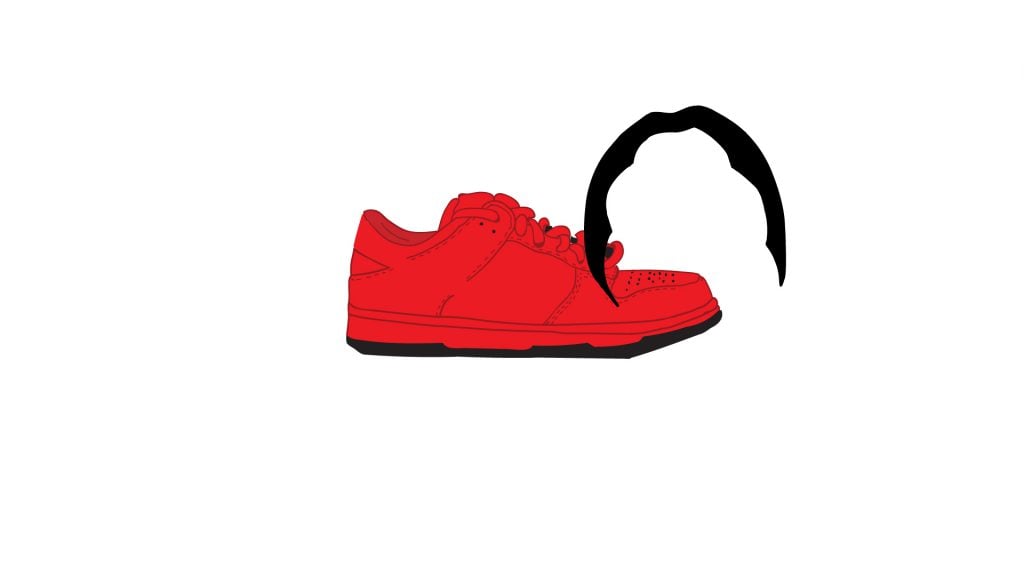
Capitalist branding is framed as a vampiric apparatus that gentrifies radical aesthetics—co-opting the avant-garde’s red/black iconography and historical fiction to convert subcultural desire into commodity power. Through metamorphic animation linking sneaker, bat, oil, castle, and factory labor, the work mobilizes postcolonial and Marxian critiques of advertising’s production of subjectivity, corporate extraction, and coerced assimilation within global supply chains.
Read more
[ KADIST ]
[ KADIST ]
[ KADIST ]
Do Not Pass Go
By staging Richie Rich’s triumph over a crushed Monopoly Man and a “dead” piggy bank, the assemblage allegorizes neoliberal competition and the violent underside of childhood consumer fantasies, where wealth is naturalized as the universal horizon of desire.
Through found-object bricolage and pop-cultural iconography, it mobilizes a comic, narrative vernacular to critique American capitalism’s myth-making—turning nostalgia into a sinister tableau of class power, commodified innocence, and market-driven social relations.
Read more

[ KADIST ]
[ e-flux ]
[ e-flux ]
Porcupette
Psychoanalytic case-note pastiche and punk’s rhetoric of destruction are braided with food/consumption fantasies to stage a critique of late-capitalist subjectivity: revolt is repeatedly metabolized into spectacle, fetish, and “care” industries, leaving symbolic violence intact while promising endless second chances.
Against this failed alchemy (gold shat, cream-pies, shock therapy, viral tears), the text searches for a nonhuman ethics of surplus and mutuality—porcupine sociality and the porcupette’s birth—as a fragile counter-model for reparative relation beyond punitive vengeance and commodified catharsis.
Read more

[ e-flux ]
[ e-flux ]
[ e-flux ]
The Future After the End of the Economy
Capitalist modernity’s mythology of “the future” as endless growth collapses under a paradigm shift from industrial labor to semiotic/cognitive production, where value becomes immeasurable by labor-time and economics functions as an ideological technology rather than a predictive science.
Financialization emerges as a deterritorialized, performative regime of signs that expropriates the “general intellect,” producing precarization and psychic exhaustion; the proposed exit is to sever futurity from investment and expansion by embracing frugality, redistribution, and cooperative solidarity as a post-futurist cultural horizon.
Read more
[ e-flux ]
[ KADIST ]
[ KADIST ]
After Scarcity
A sci-fi video-essay reactivates Soviet cybernetic planning as a suppressed genealogy of networked economic technology, using counterfactual history to contest the inevitability of today’s financialized internet and its temporal regime of speed, speculation, and high-frequency capitalism.
By collapsing documentary and futurist narration, it advances a post-financialization imaginary—regulated data infrastructures, alternative pedagogies, and “weird economies”—that reframes contemporary art’s complicity with urban renewal while reopening collective planning as a viable horizon beyond broadband idealism.
Read more
[ KADIST ]
[ KADIST ]
[ KADIST ]
A Rising Tide Lifts All Boats
A deadpan audio loop mimics the Hollywood elevator pitch to algorithmically splice incompatible cultural references, exposing how late-capitalist media logic reduces meaning to endlessly recombinable “content” and marketable novelty. By collapsing high/low and historical/pop signifiers into contradiction, the work critiques the omnipresence of mainstream media and the postmodern condition of pastiche, where cultural memory becomes a flattened database of interchangeable brands.
Read more
[ KADIST ]
[ e-flux ]
[ e-flux ]
Weapons Grade Pig Work
A manic monologue of managerial jargon and startup affect stages a satire of neoliberal “actionability,” where art-making is recoded as logistics, alignment, and deliverables, and subjectivity is reorganized around semi-autonomy, accountability theater, and perpetual optimization. By fusing corporate speech with studio life and collector-driven “appetite,” it critiques post-Fordist cultural production as a regime of performative efficiency and hype, exposing how language itself becomes an instrument of control, complicity, and aggressive mediocrity.
Read more

[ e-flux ]
[ e-flux ]
[ e-flux ]
After Nihilism, After Technic: Sketches for a New Philosophical Architecture
Late capitalism is framed as a fading name masking the rise of autonomous “Technic”—a totalizing metaphysics of instrumentality and linguistic translation that converts reality into standing-reserve, replacing nihilism’s dissolution with a new universal order of mobilization. Against this regime, a counter-architecture is proposed: an ultra-metaphysical limit grounded in the mute fact of Being, coupled with an avowedly arbitrary faith in the value of life that re-subordinates technics to ethical ends, restoring rhythm, responsibility, and mythopoetic culture as defenses and weapons.
Read more

[ e-flux ]
[ KADIST ]
[ KADIST ]
Look on the Bright Side
Artificial “moons” and perpetual illumination figure as a techno-capitalist authoritarian regime that abolishes darkness to enforce ceaseless productivity, masking ecological and psychic harm behind the myth of frictionless innovation. Mobilizing Glissant’s “right to opacity” and détournement-based image recycling, the work traces luminous spectacle back to its industrial origins, critiquing attention-economy media regimes that replace mystery and difference with homogenized visibility.
Read more

[ KADIST ]
Back to top