

A new way to explore
contemporary art and ideas
[ e-flux ]
[ e-flux ]
The Agency of (Planetary) Feeling
Planetary crisis and technocapitalist “control” are framed as a pathological narrowing of sensibility that cancels life’s norm-making capacity (Canguilhem/Dewey), yet the very affects of wrongness, depression, and disorientation can function as feedback signals and insurgent forces for new forms of reciprocity, imagination, and collective world-making.
Against semiocapitalist tautological images and extractivist posthuman spectacle (critiqued via Huyghe/Emmelhainz), the text reclaims an eco-aesthetic continuum between feeling, environment, and expression (ZAD/Weber/Haraway/Moten & Harney) while insisting—through Bachelard—on imagination’s irreducible leap beyond environmental determination.
Read more

[ e-flux ]
[ KADIST ]
[ KADIST ]
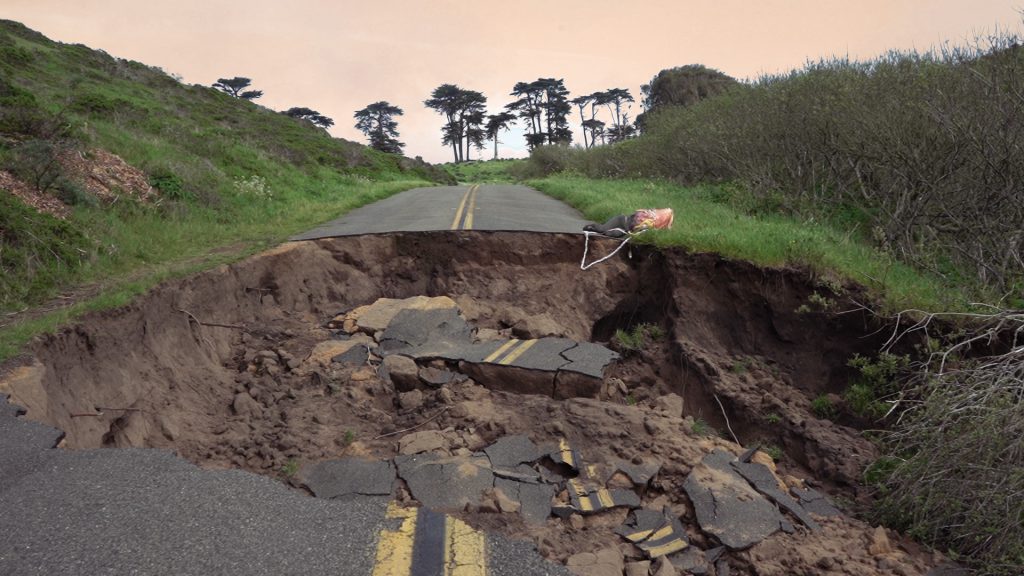
The Lonely Age
Experimental eco-dystopian mythmaking mobilizes the seed as a speculative, possibly sentient object to probe nonlinear temporalities of environmental crisis and the ideological mechanics through which hope, rumor, and skepticism are produced.
By hybridizing propaganda, documentary, and avant-garde cinema, the work critiques capitalist conditioning and colonial/racialized othering while testing whether apocalyptic romance can be ethically repurposed toward cooperative, non-hierarchical survival that acknowledges more-than-human agency.
Read more
[ KADIST ]
[ KADIST ]
[ KADIST ]
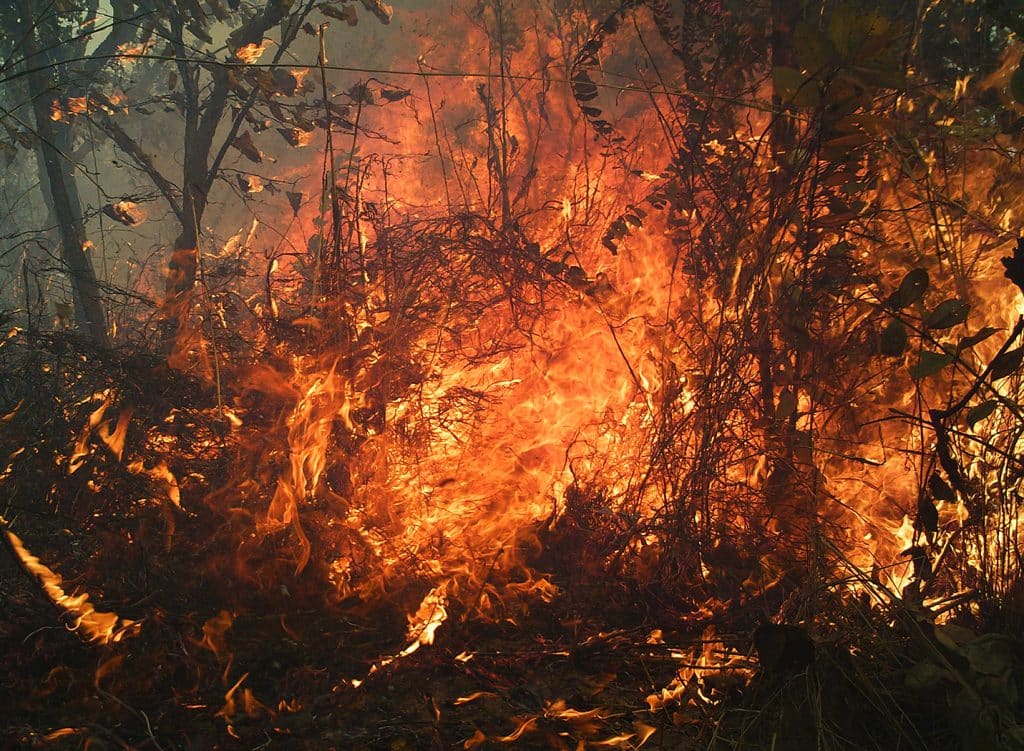
Ecotone
Ecotone mobilizes the ecological concept of a transitional zone as a philosophical model for overlap—where economic, political, historical, and social forces collide—and frames these intersections as decisive sites for imagining a shared, climate-urgent future. Through a six-chapter video-essay structure that shifts scale from satellite to molecular and foregrounds interfaces, surveillance imagery, and self-reflexive address, Rodríguez links experimental cinema to critiques of visibility, mediation, and power embedded in land and its representation.
Read more
[ KADIST ]
[ e-flux ]
[ e-flux ]
Shoreline Movements
Nonfiction cinema is framed as a relational, ecological practice capable of resisting necropolitical border regimes by turning the shoreline—an unstable threshold of land/water and contact—into a model for cohabitation amid colonial violence, environmental crisis, and unequal power.
Drawing on Mbembe, Anzaldúa, Arendt, and Latour, the program theorizes documentary as mediated “diplomatic encounter”: a performative convocation that rejects transparency and ethnographic extraction, using aesthetic experimentation (aisthesis) to produce partial yet shareable descriptions through which viewers renegotiate reality and the possibility of a common world.
Read more
[ e-flux ]
[ e-flux ]
[ e-flux ]
Revolution or Ruin
Climate breakdown is framed as an intensifying arena of class struggle in which liberal universalism, apolitical moralism, and eco-nihilist “acceptance” function as displaced forms of denial that obscure fossil capital’s agency and the imperial distribution of vulnerability.
Green New Deal–style green Keynesianism is critiqued as a contradictory social compromise that risks reproducing green imperialism and preserving the very industries it targets, prompting a call for dialectical revolutionary strategy that converts state planning’s form into an eco-communist rupture with capitalism.
Read more

[ e-flux ]
[ KADIST ]
[ KADIST ]
Gated Commune
Gated Commune stages a speculative clash between neo-primitive and techno-futurist design ideologies to expose how sustainable-development rhetoric and branding produce environments that are formally coherent yet socially dysfunctional, foreclosing rest, encounter, and genuine freedom through managed spatial scripts. By critiquing Anthropocene human-centeredness and the technocratic language that claims accessibility while serving opaque interests, the work frames sustainability discourse as a politics of design, governance, and exclusion.
Read more

[ KADIST ]
[ KADIST ]
[ KADIST ]
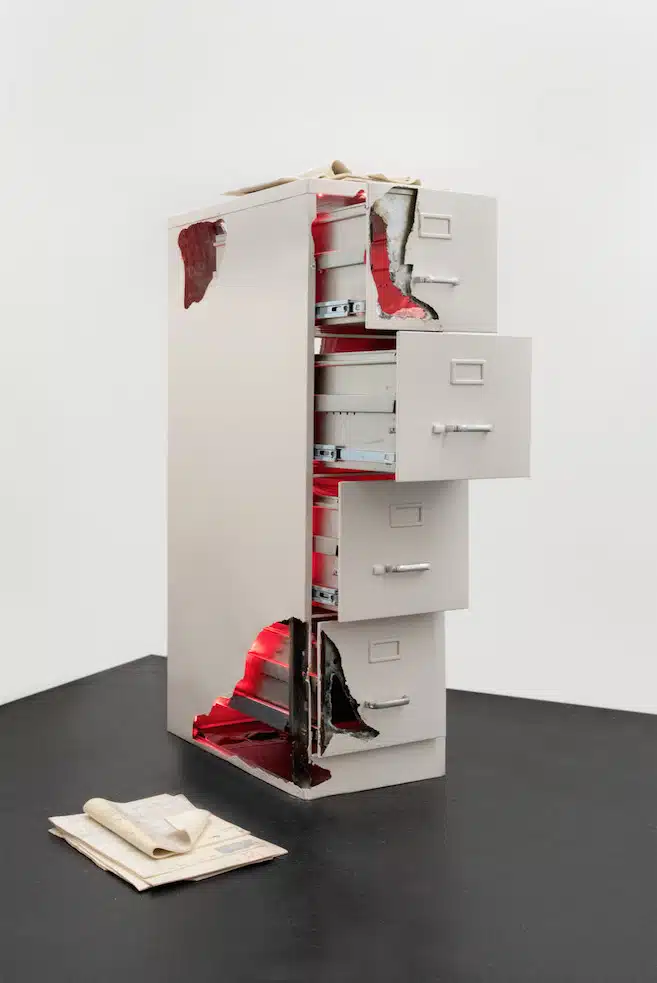
Sideways Time
Networks of finance and ecology—and their collapse—are framed as the infrastructural condition behind a fractured middle-class American identity, with architecture (scaffolds, foundations, facades) serving as both metaphor and material logic for systemic precarity. The filing cabinet becomes a pre-cloud dispositif that spatializes time and value, while bentonite, fragmented porcelain “newspapers,” and an oil-price-driven red glow stage information leakage and commodity volatility as a critique of containment, order, and the inevitability of structural failure.
Read more
[ KADIST ]
[ e-flux ]
[ e-flux ]
Editorial—“Architecture as Intangible Infrastructure,” Issue Two
Architecture is reframed as an “intangible infrastructure” of informational, ethical, and geopolitical flows that exceed building-as-object and destabilize modernist/parametric fantasies of managerial control and technological solutionism. Case studies spanning digital shelter, preservation as staged memory, labor-rights supply chains, and X-ray’s regime of transparency critique how computation, markets, and surveillance reconfigure inside/outside and expose architecture’s complicity in capital, humanitarian crisis, and new forms of visibility.
Read more
[ e-flux ]
[ e-flux ]
[ e-flux ]
The Anamorphic Politics of Climate Change
Climate change is framed as an anamorphic political object: apprehended head-on it produces a paralyzing Anthropocene sublime that feeds a Lacanian-Žižekian circuit of jouissance (catastrophe, moralism, “being in the know”) that mirrors and stabilizes capitalist enjoyment and extraction.
A partisan shift in perspective—seeking gaps within the supposed ecological whole—re-centers collective class struggle through infrastructural and institutional interventions (pipelines, museums, anti-sponsorship campaigns) that convert cultural authority into counterpower against fossil-capital and greenwashing.
Read more
[ e-flux ]
[ KADIST ]
[ KADIST ]
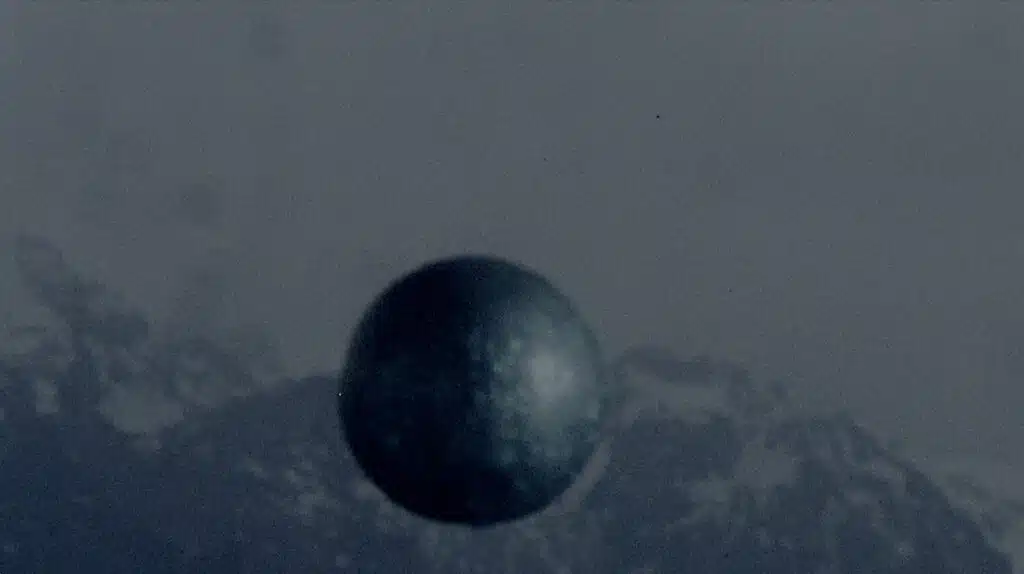
DROPSPIKE
Speculative climate-apocalypse is staged through an unrecordable, naked-eye sphere that exposes the limits of photographic evidence and technological mapping, turning perception itself into the site of ecological warning and ontological uncertainty. By privileging celluloid’s material temporality and invented imaging apparatuses, the work fuses media archaeology with science-fiction and mysticism to critique modern epistemologies, producing a dilated, melancholic time where environmental catastrophe and occult renewal coexist.
Read more
[ KADIST ]
[ KADIST ]
[ KADIST ]
Les nucléaires et les choses
Nuclear catastrophe is framed as a crisis of cultural memory in which museum artifacts become contaminated witnesses whose evacuation exposes the fragility of heritage, territorial belonging, and the epistemic authority of preservation.
By fusing documentary and performative symposium, the work mobilizes dialogic, research-based practice to contest official narratives, foregrounding how hegemonic power structures shape representation and opening a space for collective critique and political resistance.
Read more
[ KADIST ]
[ e-flux ]
[ e-flux ]
Supercritical Decay
Maps “criticality” and decay across cosmological, geological, biomedical, and geopolitical registers to show how nuclear processes bind life to entropy, temporality, and managed risk. Through a montage of isotopes, infrastructures, and scandals, it critiques technoscientific modernity and colonial power as regimes of extraction and time-management that aestheticize, normalize, and weaponize radiation while redefining the Anthropocene’s historical threshold.
Read more

[ e-flux ]
Back to top