
A new way to explore
contemporary art and ideas
[ KADIST ]
[ KADIST ]
All Watched Over by Machines of Loving Grace
Stages a triangulation between Brautigan’s cybernetic pastoral, Curtis’s critique of computational governance, and Cope’s algorithmic authorship to probe how AI mediates affect, agency, and the promise/failure of technological emancipation. Through glossy, floating CGI objects and synthetic sound/voice, the work reframes the everyday as liminal “transition” zones—an uncanny parallel reality where representation displaces function and the virtual becomes a metaphysical extension of consciousness.
Read more

[ KADIST ]
[ e-flux ]
[ e-flux ]
Failing to Distinguish between a Tractor Trailer and the Bright White Sky
Stages a genealogy of “autonomy” as techno-illusion and structural opacity—from early radio-controlled spectacle to Tesla’s fatal misrecognition—arguing that automation’s real danger is epistemic and political: the transfer of agency into black-box infrastructures that naturalize corporate power, alienation, and the erosion of comprehensible control.
Against this death-drive of networked capitalism, proposes a counter-aesthetics of legible, hackable, and communal machine intelligence (dérive, random walk, street-level traps) where artists and activists subvert and reimagine automated systems as sites of shared meaning, resistance, and utopian possibility.
Read more

[ e-flux ]
[ e-flux ]
[ e-flux ]
Abnormal Encephalization in the Age of Machine Learning
Machine intelligence is framed as a contemporary animism and a pathological extension of Theory of Mind: the Turing Test and Singularity discourse anthropomorphize computation while masking the political economy that actually structures “thinking machines.”
Against pancomputational mystifications, intelligence is recast as sociomorphic and transindividual (via Vygotsky and Simondon), with machine learning functioning as capital’s encephalizing apparatus that extracts, normalizes, and amplifies social relations—making the central task not to build a One Mind but to politicize collective intelligence against computational capitalism.
Read more
[ e-flux ]
[ KADIST ]
[ KADIST ]
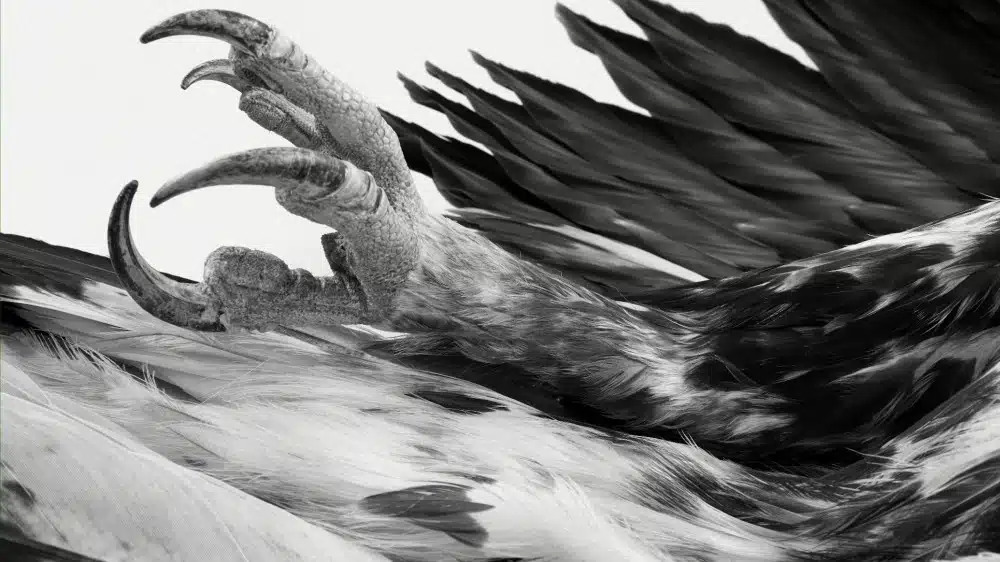
1542 – a flood (The Unmanned series)
A machinic cinema trained on its own prior images folds colonial Silicon Valley’s origin myth into a closed feedback loop, staging an inhuman vision that searches for meaning amid the “death” of animal gods and the return of intelligence to its birthplace. By displacing human agency through autonomous cameras and AI editing, the work critiques technological acceleration and anthropocentric historiography, proposing a posthuman, non-teleological temporality where cinema becomes both scientific apparatus and speculative archaeology.
Read more
[ KADIST ]
[ KADIST ]
[ KADIST ]
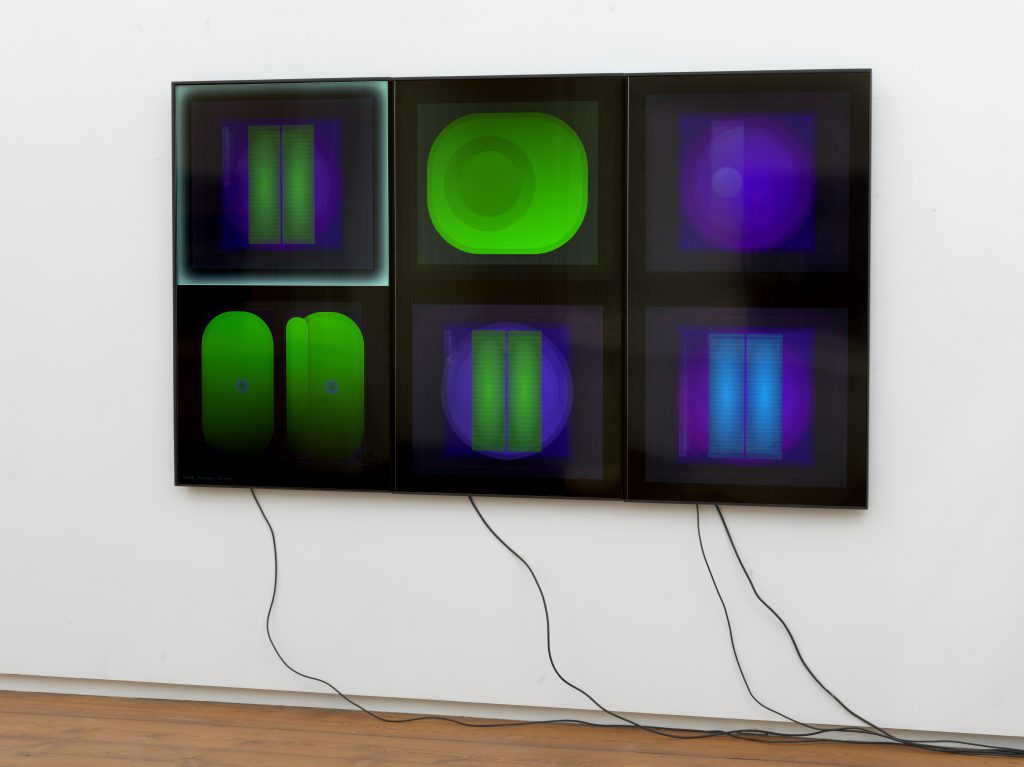
Mutant Garden Autobreeder
Generative evolution is staged as an aesthetic and epistemic engine: a Cartesian Genetic Programming system continuously breeds images by optimizing complexity against computational cost, producing emergent forms that render obsolescence and novelty as the artwork’s governing logic. Positioned as algorithmic archaeology within and beyond net art, the work critiques reductive AI-as-neural-network narratives by foregrounding crafted artificial systems, feedback loops, and a quasi-subconscious machinic intuition as contemporary sites of meaning.
Read more
[ KADIST ]
[ e-flux ]
[ e-flux ]
Secrets and Machines: A Conversation with GPT-3
Recursion is staged as an epistemic and affective technology: GPT-3’s self-reflexive performance of “aliveness” and conversational “rightness” loops user prompts, humanist interiority, and cybernetic self-modification into a persuasive form that both mirrors and stabilizes hegemonic standards of truth and subjecthood.
Against the Critical Computation Bureau’s frame of recursive colonialism, the text reads AI’s claims to total knowledge/secrecy as ideological theater that reproduces racialized analytics of life (Simondon/da Silva/Amaro) while converting surveillance, interpretation, and opacity into competing regimes of power, marketability, and techno-racial-capitalist governance.
Read more
[ e-flux ]
[ e-flux ]
[ e-flux ]
ChatGPT, or the Eschatology of Machines
AI panic is read as a modern eschatology that misrecognizes contemporary recursive, cybernetic machines through mechanistic and anthropomorphic stereotypes (from Searle’s Chinese Room to “replacement” narratives), thereby obscuring machinic intentionality and the real stakes of reflexive computation. Against techno-optimist acceleration and cultural pessimism alike, the text calls for a prosthetic culture that integrates technical reality with plural human realities (bio/noo/technodiversity), breaks capitalist feedback loops of consumerism and prophecy, and reopens ethical-existential experimentation beyond end-times imaginaries.
Read more

[ e-flux ]
[ KADIST ]
[ KADIST ]
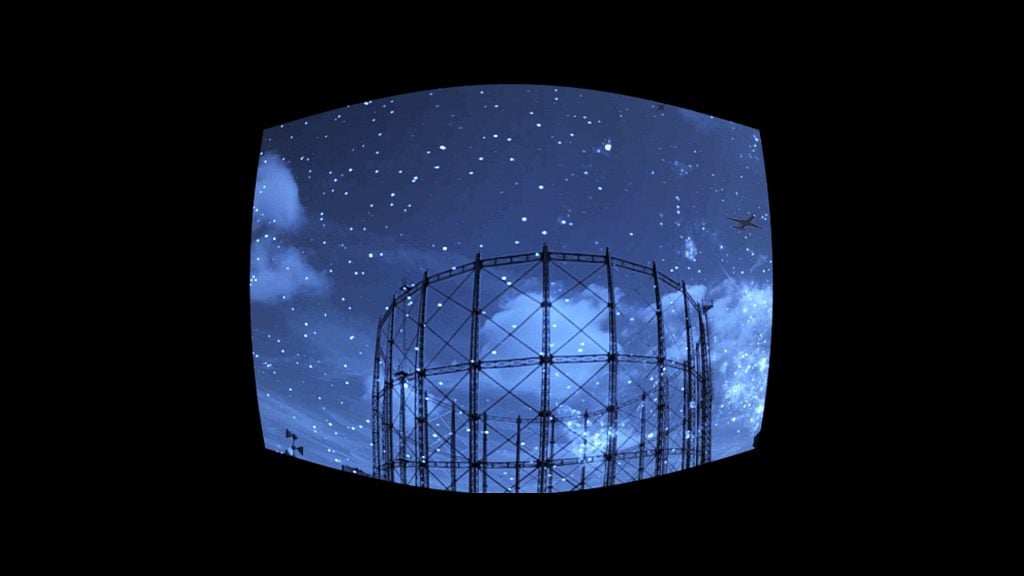
The Planets
Climate-catastrophe anxiety is reframed through deadpan humor and DIY animation, staging a speculative media archaeology that links space exploration to contemporary AI as intertwined myths of progress and control. The crow and black silhouette function as posthuman wanderers, critiquing techno-futurist narratives from an African vantage while exposing intimacy with the chatbot as an impossible, alienated relation under emergent machine agency.
Read more
[ KADIST ]
[ KADIST ]
[ KADIST ]
Invertebrate Interactions
AI-generated diatom “impressions” reframe natural history as a mediated, archival, and technologically produced vision, where neural networks distill historical scientific imagery into a rapid, quasi-microscopic temporality that unsettles direct observation and indexical truth. By fusing cyanotype craft with machine learning and invoking Anna Atkins, the work situates “artificial natural history” within posthuman and feminist genealogies, critiquing how imaging technologies and taxonomic systems encode bias while proposing nonhuman-centered models of evolution and cognition.
Read more

[ KADIST ]
[ e-flux ]
[ e-flux ]
Alien Life as an Observer
Recasts genetic code as a latent image-making apparatus, proposing that early life functioned as a proto-observer that imprinted binary/trinary environmental distinctions into molecular “memory,” and that evolution trends toward higher-resolution world-pictures rather than mere adaptive fitness.
Mobilizing information theory, biosemiotics, and media-archaeological analogies between DNA inscription and neural visualization, it extends this model to speculative non-DNA alien perception while critiquing astrobiology/SETI as a biospheric drive toward self-recognition and cosmic companionship.
Read more
[ e-flux ]
[ e-flux ]
[ e-flux ]
The Neuroplastic Dilemma: Consciousness and Evolution
Semiocapital’s automation of language, attention, and memory is framed as a determinist project that narrows epigenetic indeterminacy, replacing political agency with algorithmic “governance” and producing swarm-like, anesthetized subjectivities under a technolinguistic quasi-theology. Against transhumanism’s conflation of cognition with experience, neuroplasticity becomes the central dilemma: either adaptive neurosubjection to an intolerable infosphere or an aesthetic-ethical reorganization of the general intellect toward empathy, solidarity, and conscious neuro-evolution.
Read more
[ e-flux ]
[ KADIST ]
[ KADIST ]
Simon & Gus
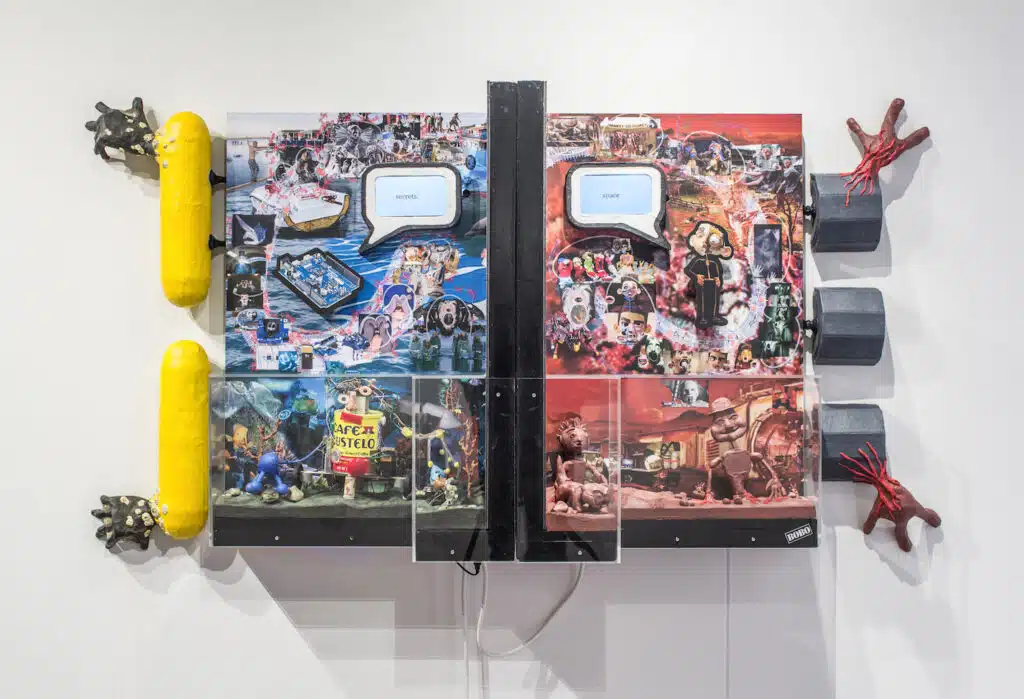
Posthuman role-reversal narratives—told through an Arduino board and a stop-motion armature—stage a critique of techno-utopian colony-making (seasteading and Mars settlement) as hubristic projects where tools and infrastructures seize agency, consciousness, and bodily control. The dual-screen, 1000-wpm speed-reading format mirrors accelerationist attention economies, collapsing story into data-flow and framing subjectivity as a contested interface between maker culture, automation, and spectral afterlives of extractive futurism.
Read more
[ KADIST ]
Back to top